 Team Bull Trading
The expensive false belief this article is built to break is simple: a trading community is only worth reviewing if it can tell me whether I will make money. That belief sounds practical, but it is the wrong test. A public Whop page cannot forecast your discipline, your risk, your account size, your schedule, your emotional control, or your ability to follow rules under pressure.
The better belief is sharper: a Team Bull Trading review should tell you whether the offer can improve the way you prepare, listen, manage risk, and review decisions. That is the real buying question. Not “will this make me money?” but “will this environment make my trading process less chaotic than it is now?”
The visible facts at research time are narrow. The Jdun monthly offer is listed at $99/month. The Jdun yearly offer is listed at $999/year. The Grizzly live-trading offer is listed at $99/month. Team Bull Trading shows a visible 4.7 rating from 474 ratings. The visible rating split shows 87% five-star, 4% four-star, 2% three-star, 0.8% two-star, and 5% one-star. The public description positions Team Bull as a comprehensive trading community. The visible FAQ prompts point toward what makes the trading floor unique and how live voice trading sessions can help.
That is enough to inspect the offer. It is not enough to promise an outcome.
Trading involves risk. Treat live trading, alerts, commentary, reviews, and community discussion as education and decision support, not a promise of profit or personal financial advice.
Table of contents
- The short verdict
- The facts you can verify
- What Team Bull is really selling
- The live trading floor feedback loop
- What the 4.7 rating actually proves
- Who Team Bull fits
- Who should skip it
- Monthly vs yearly
- How to test the first month
- FAQ
- Final decision rule
The short verdict

Team Bull Trading is worth inspecting if you want a trading education environment built around live market context, community rhythm, and discipline. It is not worth buying if you want certainty, guaranteed outcomes, or someone else’s confidence injected into your account.
That distinction is not a legal footnote. It is the whole review.
Most people search for a trading community review with the wrong hunger. They want a stranger to say, “yes, this works,” so they can skip the uncomfortable part of deciding how they will use it. But a trading room cannot carry your risk rules for you. A live voice session cannot know whether a trade fits your account. A 4.7 rating cannot tell you what you will do after two losses. A monthly subscription cannot turn an impulsive trader into a disciplined one unless the trader uses the room as a structure, not a permission slip.
The strongest case for Team Bull is not that it appears on Whop with social proof. The strongest case is the mechanism: a live environment can expose the thinking around market decisions before hindsight cleans everything up. That can be valuable. It can also be misused. A live room can help you hear reasoning, risk talk, hesitation, patience, and adjustment. Or it can become another place where you wait for someone confident to say something that lets you act without doing your own work.
So the verdict is conditional. If your current trading process is scattered, lonely, reactive, and unreviewed, Team Bull deserves a serious look. If you already have a clean process, a journal, defined risk, and a reliable learning loop, the offer has to prove it adds something specific. If you want “signals that work,” skip it. That is not the right buying frame.
The facts you can verify

The public facts are useful because they stop the review from drifting into fantasy.
The Jdun monthly offer is visible at $99/month. The yearly Jdun offer is visible at $999/year. The Grizzly live-trading offer is visible at $99/month. Team Bull Trading shows a 4.7 rating from 474 ratings. The public rating split includes a large five-star majority and a visible one-star slice. The public positioning says comprehensive trading community. The visible FAQ prompts point to the trading floor and live voice sessions.
Those are facts you can use. They tell you price, product family, public satisfaction level, and the broad shape of the offer. They do not tell you performance. They do not tell you trade quality. They do not verify profit. They do not tell you whether the room fits your schedule. They do not tell you whether the trader you listen to will explain in a way that clicks for you.
The clean way to use the facts is this:
- Price tells you the cost of inspection.
- Rating tells you there is meaningful public feedback.
- Rating split tells you not everyone is satisfied.
- Offer names tell you there are multiple live-trading paths.
- The FAQ prompts tell you live voice and the trading floor are important enough to be surfaced publicly.
The dirty way to use the facts is to treat them like outcome evidence. A 4.7 rating is not a win rate. Four hundred seventy-four ratings are not four hundred seventy-four verified trading results. A positive review is not a transferable account outcome. The price is not a promise that the room pays for itself.
That line has to stay bright. If the line gets blurry, the review becomes hype.
Related reading: Team Bull Trading Ratings: What a 4.7 From 474 Reviews Actually Signals; Team Bull Trading Complaints and 1-Star Reviews: How to Read the Risk Before Buying; Jdun Monthly vs Yearly: Should You Pay $99/month or $999/year?.
What Team Bull is really selling

A weak review would say Team Bull sells access to trading. That is too broad to be useful.
The more useful answer is that Team Bull is selling a trading environment. Environment matters because trading is not only analysis. It is timing, interpretation, risk, emotional control, and review. A trader can understand a setup on paper and still fall apart when the market moves. A trader can know what a stop is and still move it. A trader can promise to wait for confirmation and still chase.
That is why live context can be valuable. It puts the learning closer to the moment where decisions break.
But this is also where buyers get lazy. They hear “live trading” and imagine someone else doing the hard part. That is the wrong use. Live voice should not be treated as an instruction stream. It should be treated as an observation window. What is being considered? What would invalidate the idea? What is being ignored? When does patience show up? How does the speaker handle uncertainty? What happens after a loss? What does the room reward: discipline or action?
Those questions matter more than whether the room feels exciting in the first hour. Excitement is cheap. A room that makes you more impulsive is not helping, even if it feels active. A room that makes you write cleaner notes, define risk earlier, and sit out more intelligently may be helping, even if it feels less dramatic.
The product is not “pay $99 and become better.” The product is closer to this: pay for access to a live trading environment, then use that environment to pressure-test your process. If you cannot name the process you are testing, do not buy yet.
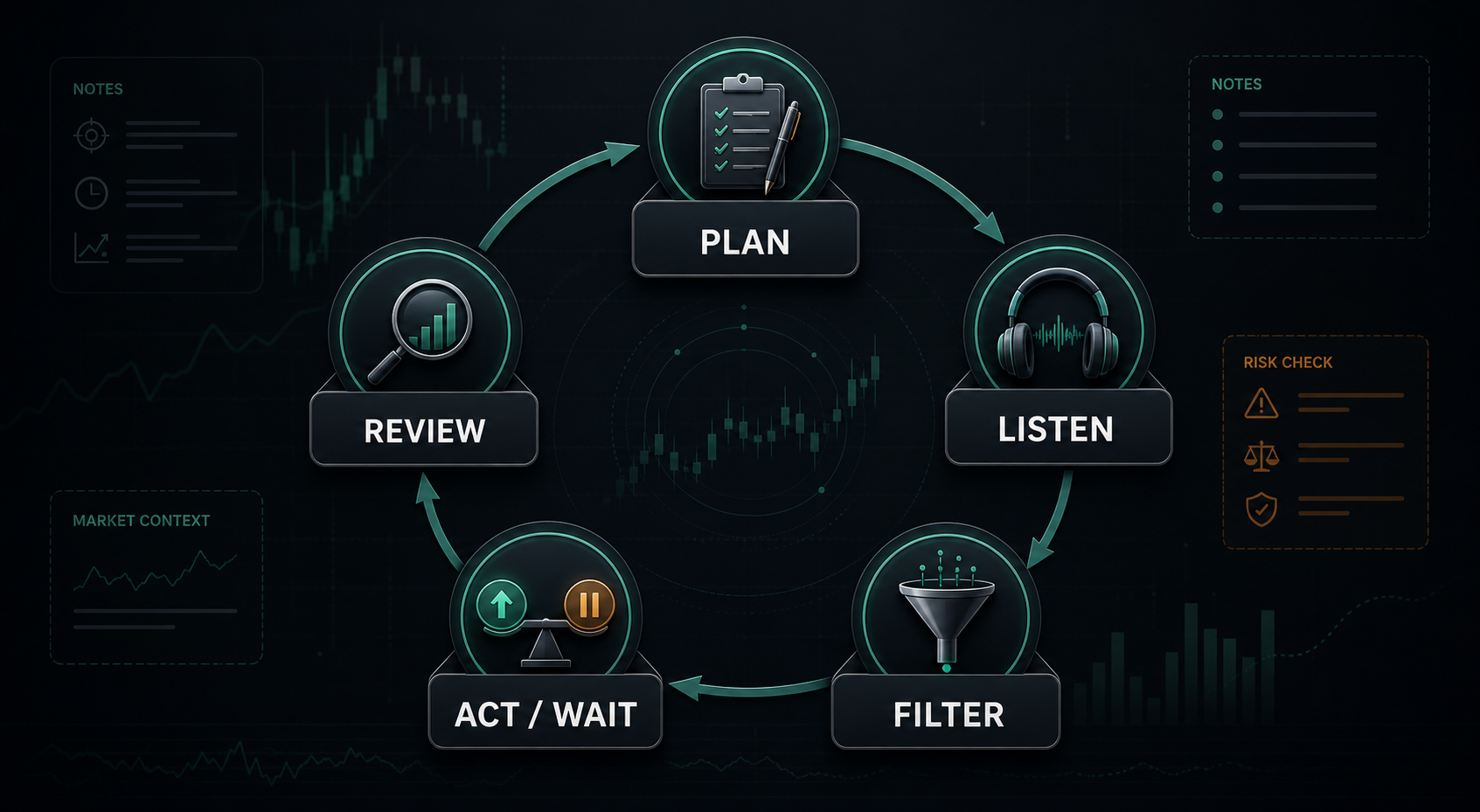
The live trading floor feedback loop

The named mechanism for this review is the live trading floor feedback loop.
Here is the loop:
1. You arrive with a plan or at least a question. 2. You listen to live market context before hindsight rewrites the decision. 3. You record the thesis, risk, invalidation, and reason to sit out. 4. You compare what happened against what was planned. 5. You review whether your action matched the process.
That loop is what separates learning from stimulation.
A trader who joins a live room without a loop is exposed to pressure. A trader who joins with a loop is exposed to data. The same room can produce very different outcomes depending on the user’s behavior. One member hears a confident sentence and reacts. Another member hears the same sentence, writes down the risk, checks whether it fits their plan, and maybe does nothing. The room did not change. The process did.
This is why the review cannot certify Team Bull as “good” or “bad” in the abstract. It can only certify the test. Does the room make the feedback loop easier to run? Does it give you more context before action? Does it help you notice emotional drift? Does it make your no-trade decisions stronger? Does it give you a repeatable way to review your week?
If yes, the monthly offer may be worth inspecting. If no, the room becomes another paid input.
What the 4.7 rating actually proves
The rating proves one thing well: many public reviewers appear satisfied enough to leave positive feedback. That matters. A 4.7 rating from 474 ratings is not nothing. It is a stronger signal than a thin offer with no visible buyer response.
But the rating does not prove what buyers most want it to prove.
It does not prove that you will trade better. It does not prove that you will manage risk. It does not prove that you will attend sessions. It does not prove that the room fits your time zone, market preference, emotional style, or experience level. It does not turn the monthly price into a guaranteed value.
The visible distribution matters because it contains friction. The five-star majority is useful proof. The one-star slice is useful too. A 5% one-star share means some buyers did not get what they wanted, did not like what they experienced, or did not fit the product. The public page does not give enough context to explain every negative rating, so do not invent explanations. Use the negative slice as a pre-mortem.
Ask yourself:
- What would make me disappointed after paying?
- Am I expecting signals or education?
- Would I blame the room if I copied without understanding?
- Do I know what a good first month looks like besides profit?
- Can I afford to test this without emotional pressure?
That is the mature way to read reviews. Positive reviews justify inspection. Negative reviews sharpen the risk.
Who Team Bull fits
Team Bull is most likely to fit the buyer who wants live context and is willing to do the boring work around it.
That buyer is not looking for a magic feed. They want to hear how traders frame market conditions. They want to compare their own thinking against live discussion. They want community rhythm because solo learning keeps dissolving into random content. They want discipline to be reinforced, not just admired. They can handle caveats. They understand that education does not remove risk.
A good-fit buyer can say something like this before joining:
“I am not buying this to copy trades. I am buying it because my current process is too scattered. I want a live environment that helps me listen for reasoning, risk, and discipline. I will test it for one month by attending, taking notes, and reviewing whether my decisions get clearer.”
That sentence is strong because it gives the membership a job.
The membership’s job is not to make the market behave. It is not to remove losing trades. It is not to recover a bad week. It is not to replace a risk plan. The job is to improve the environment around the trader’s decision-making.
If that job is real for you, the monthly offer is the cleanest inspection point.
Related reading: What Live Voice Trading Sessions Can Teach Beginners; Disciplined Trading: Why Team Bull Reviews Keep Mentioning Discipline; Before You Buy Team Bull: 21 Questions to Ask Yourself.
Who should skip it
Skip Team Bull if you want certainty.
Skip it if the real sentence in your head is “I need someone to tell me exactly what to do.” Skip it if you are trying to win back losses. Skip it if the monthly price would come from money you need for bills or trading capital. Skip it if you do not journal. Skip it if you cannot sit through live commentary without feeling pressured to act. Skip it if you judge every education product by whether it produces immediate money.
This is not moral judgment. It is buyer protection.
Trading communities attract people at emotionally vulnerable moments. Someone has lost money. Someone is tired of being alone. Someone has watched a few clips and thinks the missing piece is access. Someone sees reviews and wants permission. That is exactly when the wrong purchase feels most convincing.
The wrong buyer does not need a better CTA. They need a pause.
A paid community can amplify the trader who already has enough structure to use it. It can also amplify the trader who is reactive, overconfident, undercapitalised, or desperate. If your problem is desperation, do not buy a faster environment. Slow down first.
Monthly vs yearly
The monthly versus yearly question is simple on the surface and serious underneath.
The math: $99/month for twelve months equals $1,188. The yearly offer is $999. The annual difference is $189 if you stay all twelve months. The break-even point is a little over ten monthly payments.
That makes the yearly plan cheaper only if the fit is real.
For a first-time buyer, monthly is usually the cleaner test. Not because yearly is bad, but because the risk is not only price. The risk is fit. Does the room match your schedule? Does the style help you? Does live voice make you clearer or more impulsive? Do you actually attend? Do you review? Do you use the community, or do you just like knowing it exists?
You cannot answer those questions from the outside.
Yearly makes more sense after you have evidence. If you have already tested the room, know the fit, and can say exactly how it supports your trading week, the $999/year offer may be rational. Without that evidence, yearly is not a discount. It is confidence bought before proof.
How to test the first month
Do not test the first month by asking, “Did I make money?” That question is too noisy. A good trade can lose. A bad trade can win. A month is too short to turn outcome into truth.
Use a process test instead.
Before joining, write down your current problem. Make it specific. Not “I want to trade better.” Write “I chase after missing entries,” or “I do not define invalidation,” or “I keep changing my plan mid-trade,” or “I consume random content and never review.”
During the month, track these five things:
1. Sessions attended or meaningfully reviewed. 2. Notes taken on thesis, risk, and invalidation. 3. Decisions you chose not to take because the setup did not fit. 4. Moments where live context made your thinking clearer. 5. Moments where the room made you more reactive.
At the end, ask whether the environment improved the problem you named at the start. If yes, keep inspecting. If no, leave. That is how a subscription becomes a decision instead of a habit.
FAQ
Is Team Bull Trading legit?
The public Whop page shows visible offers, pricing, ratings, and reviews. That is enough to treat the offer as real and worth inspecting. “Legit” should not be stretched into “guaranteed to work for me.” The review evidence is about public buyer satisfaction, not your future trading results.
Is Team Bull Trading worth $99/month?
It can be worth inspecting if you will use the live environment to improve preparation, risk thinking, and review. It is not worth it if you want to copy without understanding or if the price creates emotional pressure.
Should I choose monthly or yearly?
Most new buyers should test monthly first. The yearly option can make sense after fit is proven. The annual price saves money only if you stay long enough and actually use the room.
Is Grizzly different from Jdun?
The public pages show separate live-trading offers. Jdun monthly is visible at $99/month; Grizzly is also visible at $99/month. Do not assume one is better without current product details and personal fit.
Can beginners join?
Beginners can inspect the offer, but they should arrive with caution. A beginner needs vocabulary, risk rules, and a journal before treating live commentary as useful context.
Final decision rule
Use this decision rule:
If Team Bull only sounds exciting, wait.
If your current trading process is scattered, lonely, reactive, and unreviewed, inspect the monthly offer with a first-month test plan.
If you already tested the room and know it fits your weekly routine, compare the yearly offer.
If the Grizzly path fits the live-trader comparison better, inspect that offer separately.
Relevant next reads:
- Jdun Trades vs Free Trading Content: What Are You Really Paying For?
- Team Bull Trading Ratings: What a 4.7 From 474 Reviews Actually Signals
- Team Bull Trading Complaints and 1-Star Reviews: How to Read the Risk Before Buying
- Jdun Monthly vs Yearly: Should You Pay $99/month or $999/year?
- Before You Buy Team Bull: 21 Questions to Ask Yourself
Inspect the monthly Jdun offer here: https://whop.com/team-bull-trading/team-bull-trading?a=digitalartlab
Compare the yearly Jdun offer here: https://whop.com/team-bull-trading/team-bull-yearly?a=digitalartlab
Inspect the Grizzly offer here: https://whop.com/team-bull-trading/live-trading-with-jd-copy?a=digitalartlab
Trading involves risk. Treat live trading, alerts, commentary, and community discussion as education and decision support, not a promise of profit or personal financial advice.