 Team Bull Trading
The expensive false belief here is: my trading problem is finding a better setup. That belief is expensive because it sends traders hunting for new inputs when the real leak is often execution. A trader can know the setup, see the level, hear the plan, and still break rules when the market starts moving.
The better belief is: discipline is the operating system that decides whether any trading education becomes useful. A room can provide live context. A guide can list principles. A community can create rhythm. None of it matters if the trader has no rule before entry, no risk boundary, and no review after the decision.
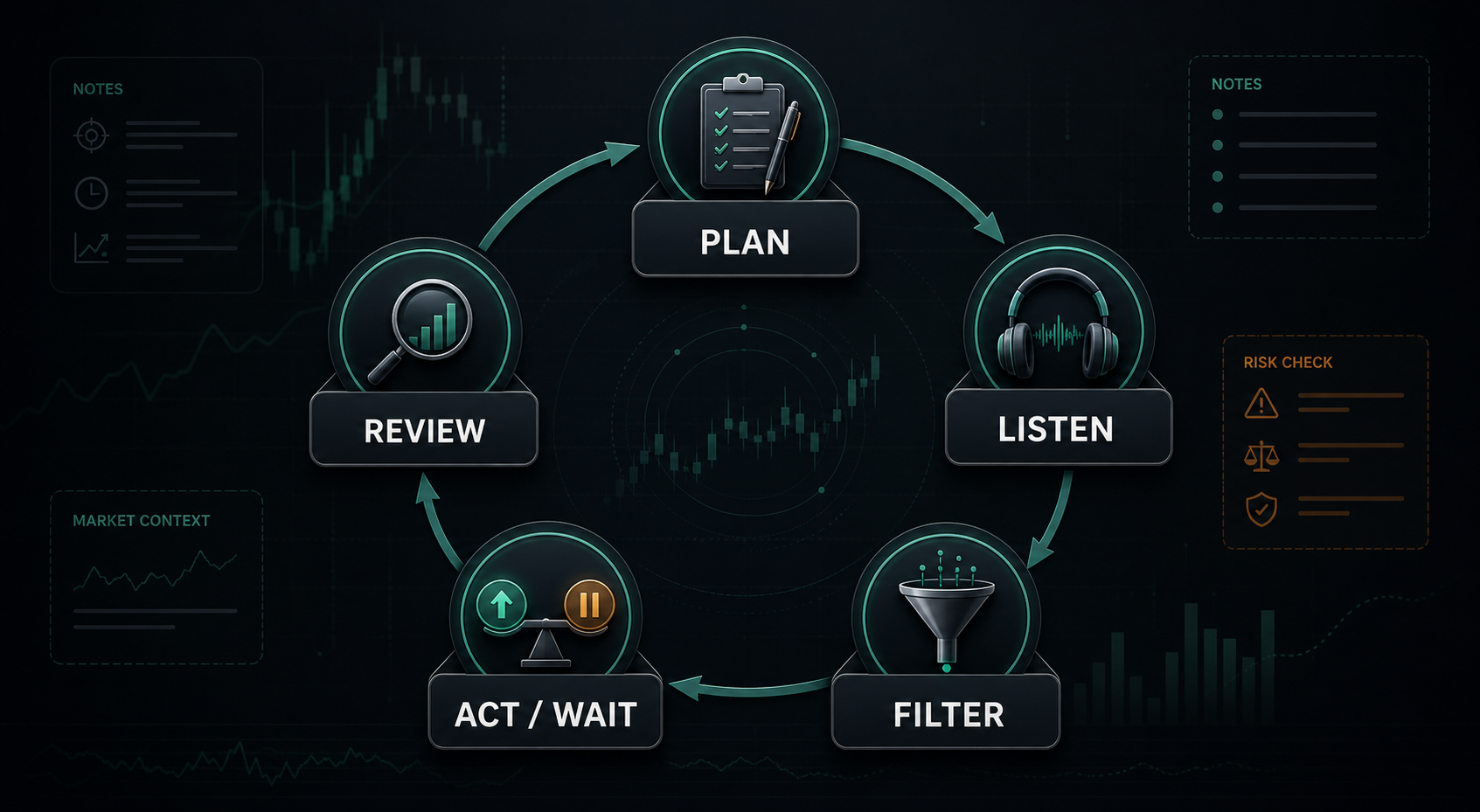
The named mechanism for this article is the rule-before-entry loop: plan the trade, define risk, define invalidation, decide what would make you do nothing, then review whether your action matched the rule. That loop is not flashy. That is why it matters.
Visible Team Bull facts at research time: Jdun monthly is listed at $99/month, Jdun yearly at $999/year, and Grizzly at $99/month. Team Bull shows a visible 4.7 rating from 474 ratings. The visible split shows 87% five-star and 5% one-star, among other ratings. A related free product is visible around disciplined trading and 11 principles. That guide does not prove trading outcomes, but it makes discipline a central lens for evaluating the ecosystem.
Trading involves risk. Treat live trading, commentary, alerts, and community discussion as education and decision support, not a promise of profit or personal financial advice.
Table of contents
- Why discipline is the real product
- The free guide clue
- Rules before entries
- How live rooms expose drift
- The journal test
- When discipline talk becomes empty
- A weekly discipline routine
- How this links to the Team Bull buying decision
- FAQ
- Final decision rule
Why discipline is the real product
Discipline sounds soft until you look at where trades actually break.
Most bad trading decisions do not begin with total ignorance. They begin with a trader knowing enough to be dangerous. The trader knows what a setup should look like, but enters early. Knows where the idea is invalidated, but moves the stop. Knows they should size down after a rough streak, but presses harder. Knows they should wait, but treats waiting as missing out.
That is why discipline is not decoration. It is not the motivational wrapper around the real product. For trading education, discipline is often the product’s real test.
A trading community can give you more market context. That context helps only if it is filtered through rules. Without rules, more context becomes more permission. One trader hears live commentary and writes down the conditions that would make a trade valid. Another hears the same commentary and clicks because the voice sounded confident. Same room. Different operating system.
Team Bull should be judged through that lens. If the environment reinforces patience, risk thinking, review, and process, discipline is not just branding. If it only creates excitement, discipline is just a word people say after a win.
Related reading: Team Bull Trading Review: What You Actually Get Before Joining; Risk Management Lessons to Look For in a Trading Community.
The free guide clue
The related free discipline guide matters, but not because it proves anything about your account.
It matters because it tells you what the public Team Bull ecosystem wants to be associated with: principles, discipline, and trading habits. A serious buyer should use that as a standard. If discipline is central enough to appear in the free offer, then the paid experience should be evaluated by whether discipline shows up in the actual learning rhythm.
Do not overread the guide. A free guide cannot make anyone disciplined. A paid room cannot do that either. Principles become useful only when they are converted into rules you can follow under pressure.
The practical question is: what would you do with those principles during a live session?
If a principle says patience matters, what is your patience rule? If a principle says risk matters, what is your risk rule? If a principle says consistency matters, how will you measure consistency besides account outcome?
That is how a guide becomes more than content. It becomes a filter.
A buyer who cannot translate principles into behavior is not ready for a faster live room. That buyer should slow down and build the rules first. A buyer who can translate principles into behavior may get more value from the paid environment because the room gives those rules a place to be tested.
Rules before entries
The phrase “rules before entries” is the heart of this article.
An entry is seductive because it feels like action. A rule is less exciting because it limits action. That is exactly why the rule has to come first.
Before any trade idea, a trader should know:
- What setup am I actually waiting for?
- What would make the idea wrong?
- Where is the invalidation point?
- How much am I willing to risk?
- What market condition would make me sit out?
- What emotional state would make me stop for the day?
Those questions sound basic. They are not basic when the market is moving.
Live commentary can make entries feel urgent. The trader hears a level, a ticker, a tone, or a possible direction. Without rules, the brain turns that information into permission. With rules, the same information becomes context.
That is the difference between using a trading room and being used by it.
Team Bull’s live trading angle should be evaluated by whether it supports the rule-before-entry loop. Does the room make it easier to hear risk? Does it normalise waiting? Does it discuss invalidation? Does it treat no-trade decisions as part of trading? Those are discipline signals.
How live rooms expose drift
A live room exposes drift because it puts pressure on the plan.
Alone, you can tell yourself you are disciplined. You can write a clean rule in the morning and feel serious. Then a live idea appears, someone sounds confident, the chart starts moving, and suddenly the rule becomes negotiable.
That moment is useful if you observe it honestly.
The room did not “make” you chase. It revealed that your rule was not strong enough under pressure. That is feedback. Painful feedback, but useful feedback.
A trader using Team Bull well should notice drift in real time. When did I want to copy? When did I ignore my size rule? When did I feel fear of missing out? When did I want someone else to decide? When did I treat commentary as command?
Those notes are more valuable than pretending every session has to produce a trade. Some sessions should produce restraint. Some should produce a better question. Some should produce a clearer rule. If the room helps you see your own drift, it may be doing useful work.
The journal test
A discipline claim without a journal is hard to inspect.
The journal test is simple: after a live session, can you write what happened in a way that separates process from outcome?
Do not write only whether the trade won or lost. Write the actual decision chain:
- What was the trade idea or market context?
- What did I understand before acting?
- What risk was defined?
- What would have invalidated the idea?
- Did I act, wait, or sit out?
- Did my action match my rule?
- What emotion was strongest?
- What should I repeat or remove next time?
That is discipline in visible form.
If the journal improves after joining a live room, the room may be helping. If the journal disappears because the room becomes too exciting, the room may be harming your process. That is not necessarily the product’s fault. It is still your buying problem.
Related reading: How to Journal Trades While Following a Live Trading Room; Trading Psychology After a Losing Streak.
When discipline talk becomes empty
Discipline talk becomes empty when it never costs anything.
It is easy to praise discipline after a trade works. It is easy to say “stick to the plan” when the plan feels comfortable. It is easy to admire patience when nothing is moving. The test is what happens when discipline blocks the thing you want to do.
Discipline costs you the early entry. It costs you the oversized trade. It costs you the revenge attempt. It costs you the chance to turn boredom into action. It costs you the fantasy of certainty.
That is why a serious buyer should be suspicious of any community, room, or article that uses discipline as a slogan but rewards constant action. The room’s culture matters. What gets praised? What gets repeated? What gets ignored? What happens when someone asks a vague question? What happens when the market is messy?
If the environment treats discipline as a living rule, useful. If it treats discipline as branding, weak.
A weekly discipline routine
Here is a simple routine for the first month.
Before the week starts, write three rules. Not twenty. Three.
One risk rule. One entry rule. One stop rule.
During live sessions, write down any moment where you wanted to break one of those rules. Do not judge it yet. Just mark the moment.
After each session, write a short review:
- Did I follow the rule?
- If not, what pressure broke it?
- Did live commentary make me clearer or more reactive?
- What do I need to change before the next session?
At the end of the week, review the pattern. If the same rule keeps breaking, the problem is not more content. The problem is friction. Make the rule easier to follow, reduce size, slow down, or sit out more.
This routine turns Team Bull from a content source into a discipline lab. That is the highest-value use case.
How this links to the Team Bull buying decision
The buying decision is not “do I like the idea of discipline?” Everyone likes the idea of discipline.
The buying decision is “will I use this environment to practice discipline when it costs me action?”
If yes, the monthly offer deserves inspection. If no, the free guide, free basics, and private journaling may be the better first step.
The visible monthly price is $99/month. That is the cost of testing whether live structure reinforces your rules. The yearly price is $999/year, but yearly is not the discipline path for a new buyer. Monthly is the test. Yearly is for after fit is proven.
FAQ
Does discipline guarantee better trading results?
No. Discipline does not remove market risk. It helps make decisions more reviewable and may reduce impulsive mistakes, but it does not guarantee outcomes.
Why does discipline matter in a live trading room?
Because live commentary can create pressure. Discipline decides whether commentary becomes context or a trigger.
Should beginners focus on discipline first?
Yes. Beginners need vocabulary and risk basics, but discipline is what keeps those basics from disappearing under pressure.
Is the free discipline guide enough?
It may be enough for some buyers to start. The paid room should be considered only if you want a live environment to practice and test those principles.
Final decision rule
Say this before clicking:
“I am not looking for a better setup. I am looking for an environment that helps me follow rules before entries.”
If that sentence is true, inspect the monthly Jdun offer here: https://whop.com/team-bull-trading/team-bull-trading?a=digitalartlab
If you are comparing commitment levels, read Jdun Monthly vs Yearly: Should You Pay $99/month or $999/year?.
Trading involves risk. Treat live trading, commentary, alerts, and community discussion as education and decision support, not a promise of profit or personal financial advice.