 Team Bull Trading
The expensive false belief here is: if I can hear a trader live, I can copy the decision and skip the hard parts. That belief is dangerous because it turns education into borrowed urgency. A voice in a room can sound calm, certain, and experienced. That does not mean the idea fits your account, your risk, your plan, your experience, or your emotional state.
The better belief is: live voice trading is useful when it transfers context, not when it replaces judgment. The named mechanism for this article is real-time context transfer. Live voice can show how a trader frames a decision before hindsight cleans up the story. It can reveal hesitation, patience, invalidation, and adjustment. It cannot make a trade personally suitable for you.
The visible Team Bull facts are narrow. Jdun monthly is listed at $99/month, Jdun yearly at $999/year, and Grizzly at $99/month. Team Bull shows a visible 4.7 rating from 474 ratings. The public FAQ prompts mention live voice trading sessions. That makes live voice central enough to inspect, but not strong enough to promise outcomes.
Trading involves risk. Treat live trading, commentary, alerts, and community discussion as education and decision support, not a promise of profit or personal financial advice.
Table of contents
- What live voice can do
- What live voice cannot do
- The context you should listen for
- Risk before entry
- Why copying is the trap
- How to take session notes
- Jdun or Grizzly
- A first-week listening plan
- FAQ
- Final decision rule
What live voice can do
Live voice can remove the fake cleanliness of hindsight.
That is its biggest educational advantage. A recorded lesson often begins after the hard part has been resolved. The speaker already knows what happened. The chart can be paused, marked, edited, and explained in a neat line. Live commentary is different. The candle is still forming. The market can still reject the idea. The speaker has to deal with uncertainty in public.
That uncertainty is the useful part.
A live session can show how a trader talks through conditions before acting. It can show when a setup is not clean enough. It can show what gets ignored. It can show whether the room treats sitting out as a real decision. It can expose the difference between a planned entry and a chase. It can teach vocabulary in context: thesis, invalidation, stop, size, patience, continuation, rejection, risk.
This is valuable for beginners because beginners often learn trading as a set of static definitions. They know what words mean, but not when those words matter. Live voice puts the words into a moving environment.
It can also be valuable for traders who already know analysis but struggle with execution. They may not need another chart-pattern lesson. They may need to hear how someone handles ambiguity, reduces risk, or waits when the market is not giving a clean trade.
Related reading: Team Bull Trading Review: What You Actually Get Before Joining; Disciplined Trading: Why Team Bull Reviews Keep Mentioning Discipline.
What live voice cannot do
Live voice cannot know your risk.
That one sentence should sit above every trading room. A speaker can describe a setup. They cannot know whether the setup belongs in your account. They do not know your position size, your open trades, your loss limit, your experience, your sleep, your stress, your history with revenge trading, or the amount of money you can afford to lose.
Live voice also cannot make you disciplined. It can model discipline. It can remind you of risk. It can create a room where process is discussed. But you still have to decide whether to follow your own rules.
It cannot turn a vague trader into a precise trader by osmosis. If you enter the room with no journal, no plan, and no risk boundaries, live commentary may make you faster, not better. The speed is the danger. A slow mistake gives you time to notice it. A live room can make the mistake feel social and urgent.
Live voice cannot remove losing trades either. Losing trades are part of trading. The educational question is not “did this idea win?” The better question is “was the idea framed with a thesis, risk, invalidation, and reviewable process?”
If you expect live voice to replace judgment, the offer is wrong for you. If you expect live voice to expose decision-making under pressure, it may be worth inspecting.
The context you should listen for
Most buyers listen for the wrong thing.
They listen for the ticker. They listen for the direction. They listen for the entry. They listen for the sentence that gives permission. That is the lowest-value way to use live voice.
Listen for context instead.
What market condition is being discussed? Is the idea tied to a level, a pattern, news, volume, trend, range, or timing? What would make the idea wrong? Is there a reason to wait? Is there a reason to reduce size? Is the speaker talking about the trade as one idea among many, or as a must-take opportunity?
Listen for silence too. What does the room not take? What gets passed on? What setups are rejected? Beginners often think trading skill is shown only through action. A useful live room can also teach restraint.
The best notes from a live session are not “buy here” or “sell there.” They look more like this:
- Market condition discussed.
- Setup considered.
- Reason for interest.
- Risk or invalidation mentioned.
- Reason to wait or avoid.
- What I understood.
- What I did.
- Whether my action matched my plan.
That note structure turns live voice into education.
Risk before entry
Risk has to come before entry because entry is emotionally louder.
The human brain wants the action point. Where do I get in? What happens next? Is this the moment? That is why risk language matters so much in a live room. Risk slows the decision down.
Before acting on anything heard live, you should be able to answer:
- What is the trade idea?
- What would make it wrong?
- Where would I be out?
- How much would I risk?
- Does this fit my plan?
- Am I acting because it fits or because I feel late?
If those answers are not clear, the trade is not ready for you. It might be ready for someone else. That distinction matters. A live idea can be reasonable and still not be yours.
This is where Team Bull’s live voice angle should be tested. Does the room make risk easier to hear? Does it talk about invalidation before excitement? Does it encourage members to think independently? Does it make sitting out feel acceptable?
If yes, live voice has educational value. If no, the room may still be active, but activity is not the same as usefulness.
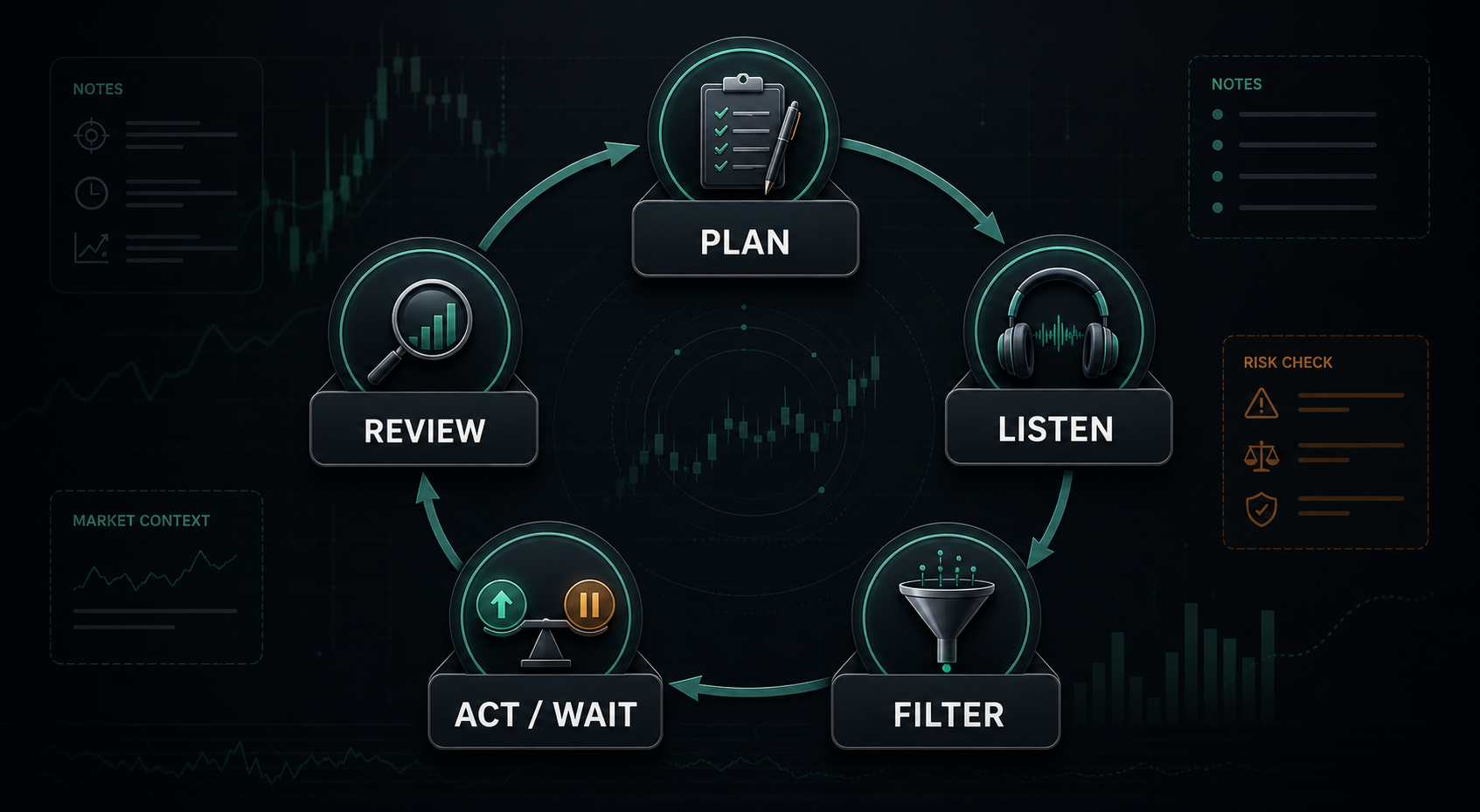
Why copying is the trap
Copying feels efficient because it removes thought at the exact moment thinking is uncomfortable.
That is the trap.
A copied trade is not just borrowed information. It is borrowed timing, borrowed confidence, borrowed risk, and borrowed emotional tolerance. You may copy the entry but not the exit discipline. You may copy the idea but not the size. You may copy the thesis but not understand invalidation. You may copy the first decision and panic on the second.
The problem is not that trade ideas are useless. Trade ideas can be valuable when paired with explanation. The problem is treating the idea as instruction.
A healthy live-room habit sounds like this:
“I heard the idea. I understand the context. I know what would make it wrong. It fits my plan, or it does not. If it does not fit, I do nothing.”
An unhealthy habit sounds like this:
“I heard confidence. I do not want to miss it. I will click now and understand later.”
The second habit can turn any room into a risk amplifier.
How to take session notes
Session notes should be short enough to keep live and detailed enough to review.
Use a simple template:
- Time.
- Market condition.
- Idea discussed.
- Reason for interest.
- Risk or invalidation.
- Decision: act, wait, or ignore.
- Emotion: calm, rushed, afraid, greedy, confused.
- Review after session.
The emotion line is important. Many traders do not lose discipline because they lack information. They lose discipline because a feeling becomes a reason. If live voice makes you feel rushed, write that down. If it makes you calmer, write that down too.
After the session, review your notes without judging only the outcome. Ask whether the decision was clean. Did you understand before acting? Did you size according to your plan? Did you sit out when the idea was not yours? Did the room help you think or make you react?
That review is where live voice becomes useful.
Related reading: How to Journal Trades While Following a Live Trading Room; Live Trading Room Etiquette: How to Learn Without Becoming Dependent.
Jdun or Grizzly
The public offer pages show two visible monthly live-trading paths: Jdun at $99/month and Grizzly at $99/month.
That means the decision is not solved by price. It is solved by fit.
Fit means schedule, teaching style, market focus, explanation style, and how the room affects your behavior. A trader who helps you slow down is more useful than a trader who merely makes you feel bold. A room that gives you better notes is more useful than a room that gives you more adrenaline.
Do not assume one is better because you want the choice to be easy. The public pages do not prove that. The honest move is to inspect the current offers, compare how each path is presented, and choose the first monthly test based on how you learn.
If you already know you want Jdun and you have tested fit, the yearly offer may be worth comparing. If you are new, monthly is the cleaner research path.
A first-week listening plan
For the first week, do not make live voice a performance test.
Make it a listening test.
Day one: listen for vocabulary and rhythm. Do not judge the room by one idea.
Day two: write down every mention of risk, invalidation, or patience.
Day three: write down every moment you felt pressure to act.
Day four: compare your notes to your own plan.
Day five: review whether your thinking got clearer or louder.
At the end of the week, ask: do I understand the room better, and do I understand myself better inside the room?
If yes, continue the month. If no, wait before committing further.
FAQ
Are live voice trading sessions signals?
Treat them as educational context, not personal signals. Your own plan and risk rules decide whether you act.
Can beginners benefit from live voice?
Yes, if they listen for reasoning and vocabulary before trying to act. Beginners who copy immediately may build dependency instead of skill.
Should I choose Jdun or Grizzly?
Both visible monthly offers are listed at $99/month. Compare fit, style, and how each path affects your decision process. Do not invent a performance difference from public pricing alone.
What is the biggest live voice mistake?
Copying without context. Hearing an idea is not the same as owning the risk.
Final decision rule
Say this before clicking:
“I am inspecting live voice trading because I want to hear decision-making under pressure, not because I want to outsource my trades.”
If that sentence is true, inspect the Jdun monthly offer here: https://whop.com/team-bull-trading/team-bull-trading?a=digitalartlab
Inspect the Grizzly offer here: https://whop.com/team-bull-trading/live-trading-with-jd-copy?a=digitalartlab
If you need the broader review first, read Team Bull Trading Review: What You Actually Get Before Joining.
Trading involves risk. Treat live trading, commentary, alerts, and community discussion as education and decision support, not a promise of profit or personal financial advice.