

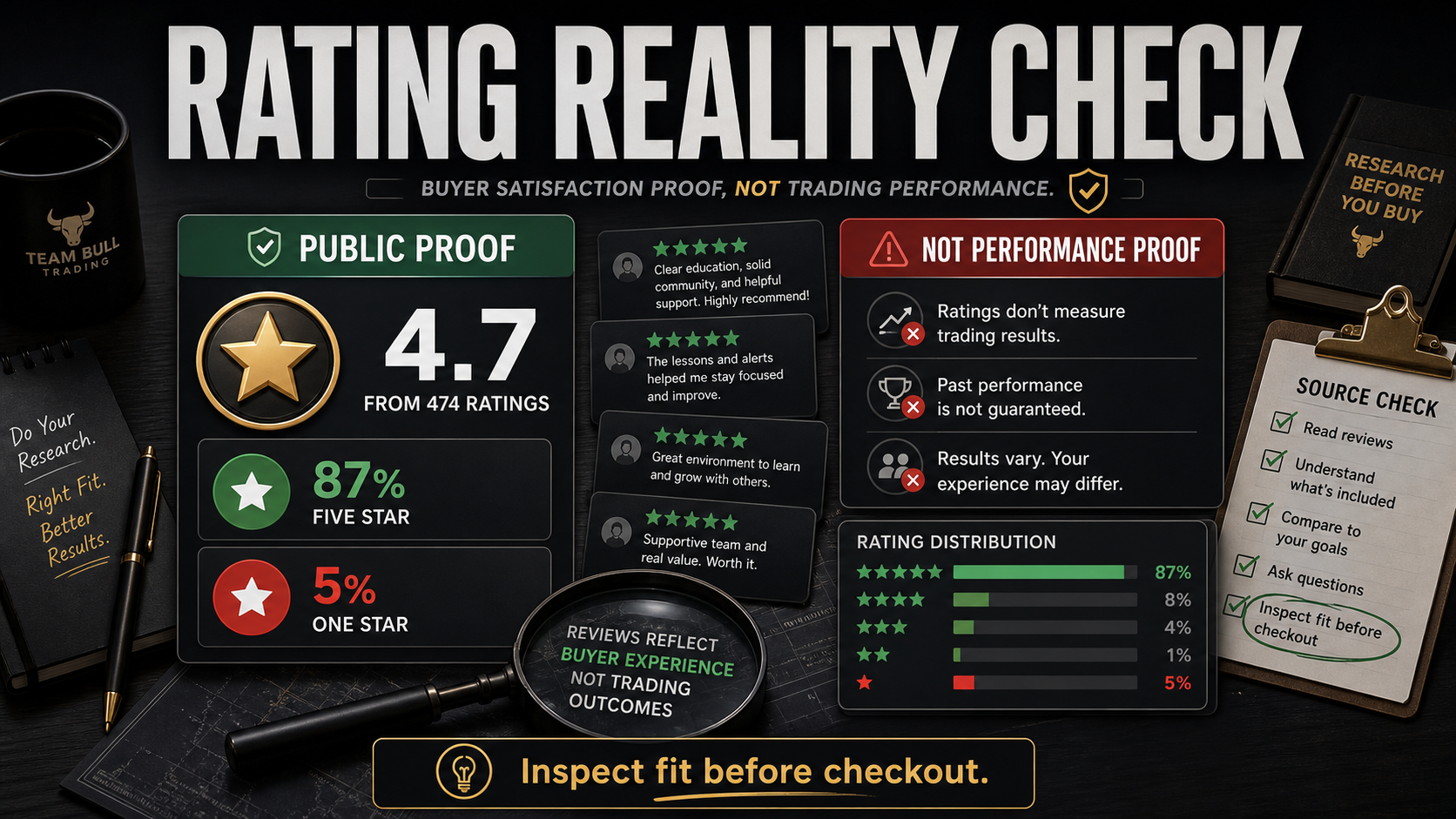
From 474 visible ratings

Read this before you pay
You are not buying certainty. You are deciding whether this room belongs in your trading week.
If you need someone to carry your trades, leave this alone. If you want live context you can test with notes, risk rules, and a clear cancellation line, start with the monthly inspection.
The second before a live room helps or hurts you
Picture the moment that matters. The market is moving, a candle is stretching, a voice in the room sounds certain, and your hand gets closer to the mouse. You are not calmly comparing education products anymore. You are in the exact state where traders make expensive decisions: alert, impatient, slightly behind, trying to turn someone else's clarity into your own action.
That is the moment you need to inspect before you buy Team Bull Trading. Do not ask only whether the room looks active. Ask what you will do when the room is active, when the commentary is fast, when a trade idea sounds good, when you missed the first move, when another member sounds excited, and when your account is the only account you can actually control.
A live trading environment can be useful because it moves education closer to the decision. You hear market context before hindsight cleans it up. You hear hesitation, invalidation, waiting, conviction, and adjustment while the chart is still alive. That can make your process less lonely and less random. It can also make you more reactive if you treat the room like permission to act. The same room can be a mirror or a trigger. The difference is your loop.
Team Bull is not a profit vending machine
The first belief to kill is the expensive one: a trading community is only worth buying if a stranger can promise you will make money. That belief feels practical because money is the visible scoreboard. It is still the wrong buying test. No public offer can know your account size, your discipline, your risk limits, your schedule, your emotional control, your trade history, your broker, your market preference, or whether you move your stop when the room gets loud.
The better buying test is narrower and more useful: can this environment improve the way you prepare, listen, filter, act, wait, and review? That is the job a live education room can reasonably apply for. It can give you context. It can expose process. It can add community rhythm. It can help you hear how another trader thinks through a live market. It cannot remove risk. It cannot make your plan for you. It cannot turn copying into judgment.
That is why the warning matters: do not copy blind. If that warning feels annoying, the offer is probably not for you yet. If the warning feels like relief, because you already know your issue is chaos rather than access, then Team Bull deserves inspection. Evaluate the membership as a structured environment, not as a magic feed.
The facts are strong enough to inspect and too narrow to overclaim
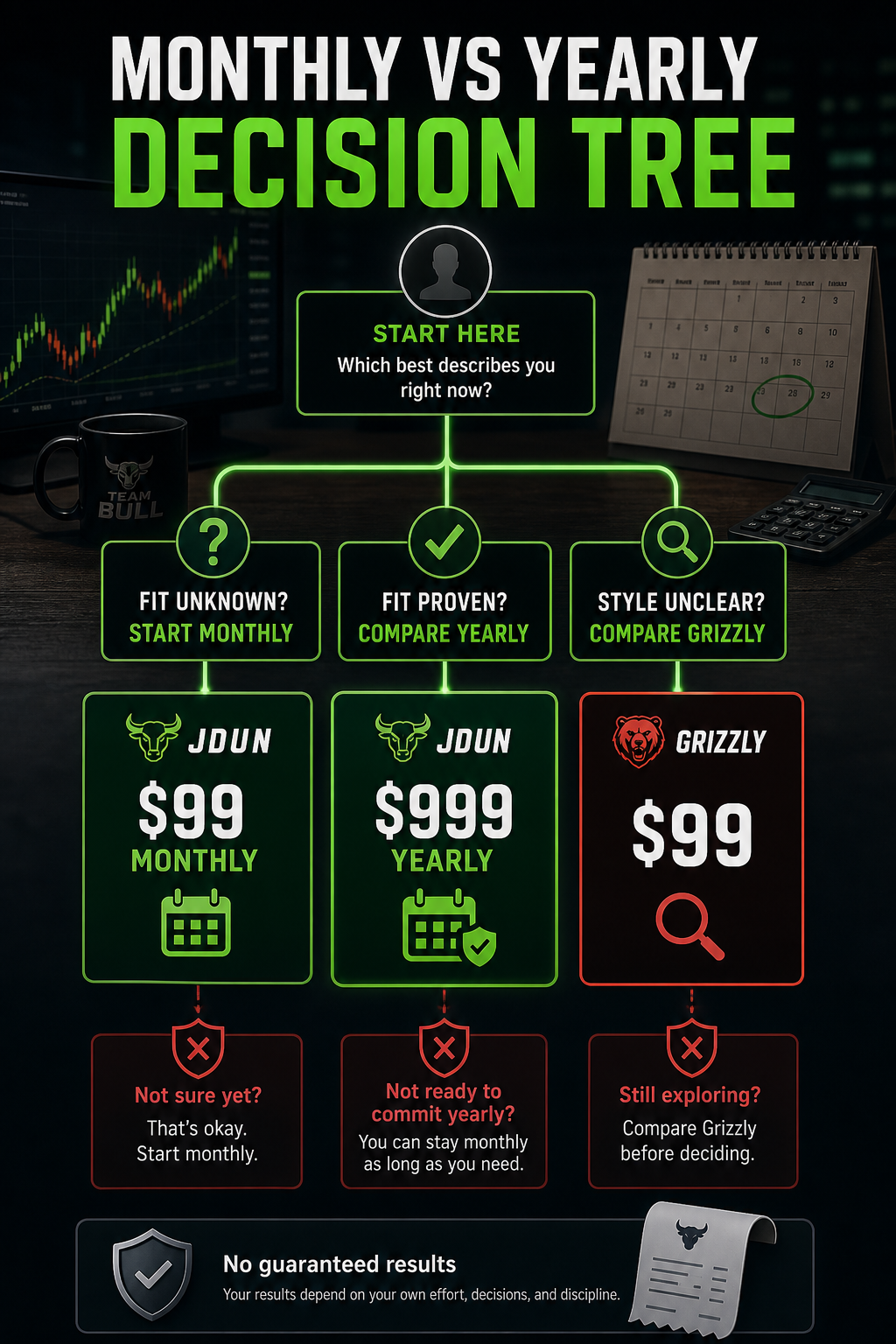
Start with the facts you can actually verify. Jdun monthly is listed at $99/month. Jdun yearly is listed at $999/year. Grizzly live trading is listed at $99/month. Team Bull Trading shows a visible 4.7 Whop rating from 474 ratings. The visible rating split includes an 87% five-star share and a 5% one-star share. The public positioning points toward a trading floor, live voice, community, and education around market context.
Those facts matter. They mean this is not a thin offer with no visible response. They also stop you from pretending to know things the public facts cannot prove. A 4.7 rating is not a win rate. Four hundred seventy-four ratings are not four hundred seventy-four verified trading statements. A positive review is not a transferable account result. A $99 price point is not evidence that the room pays for itself.
Use the public facts the clean way. Price tells you the cost of inspection. Rating volume tells you there is meaningful public feedback. Rating split tells you satisfaction is high but not universal. Offer paths tell you the choice includes monthly, yearly, and mentor-style comparison. None of that proves personal fit. Turn those facts into a buying process instead of a fantasy.
The real value equation is not bigger promises
A useful offer raises the dream outcome, raises the perceived likelihood of achievement, lowers the time delay to a first useful result, and lowers the effort or sacrifice required to keep using it. In trading, the dangerous version of that equation becomes hype: promise a huge financial outcome, imply the odds are high, pretend the result is fast, and hide the work. You should use the opposite test.
The dream outcome here is not guaranteed profit. The dream outcome is a clearer trading week: fewer random inputs, cleaner notes, better risk questions, stronger no-trade decisions, and a room where live context can be converted into review material. The likelihood proof is not performance proof. It is public response, visible pricing, multiple offer paths, and a first-month protocol that lets you test whether the room changes your behavior.
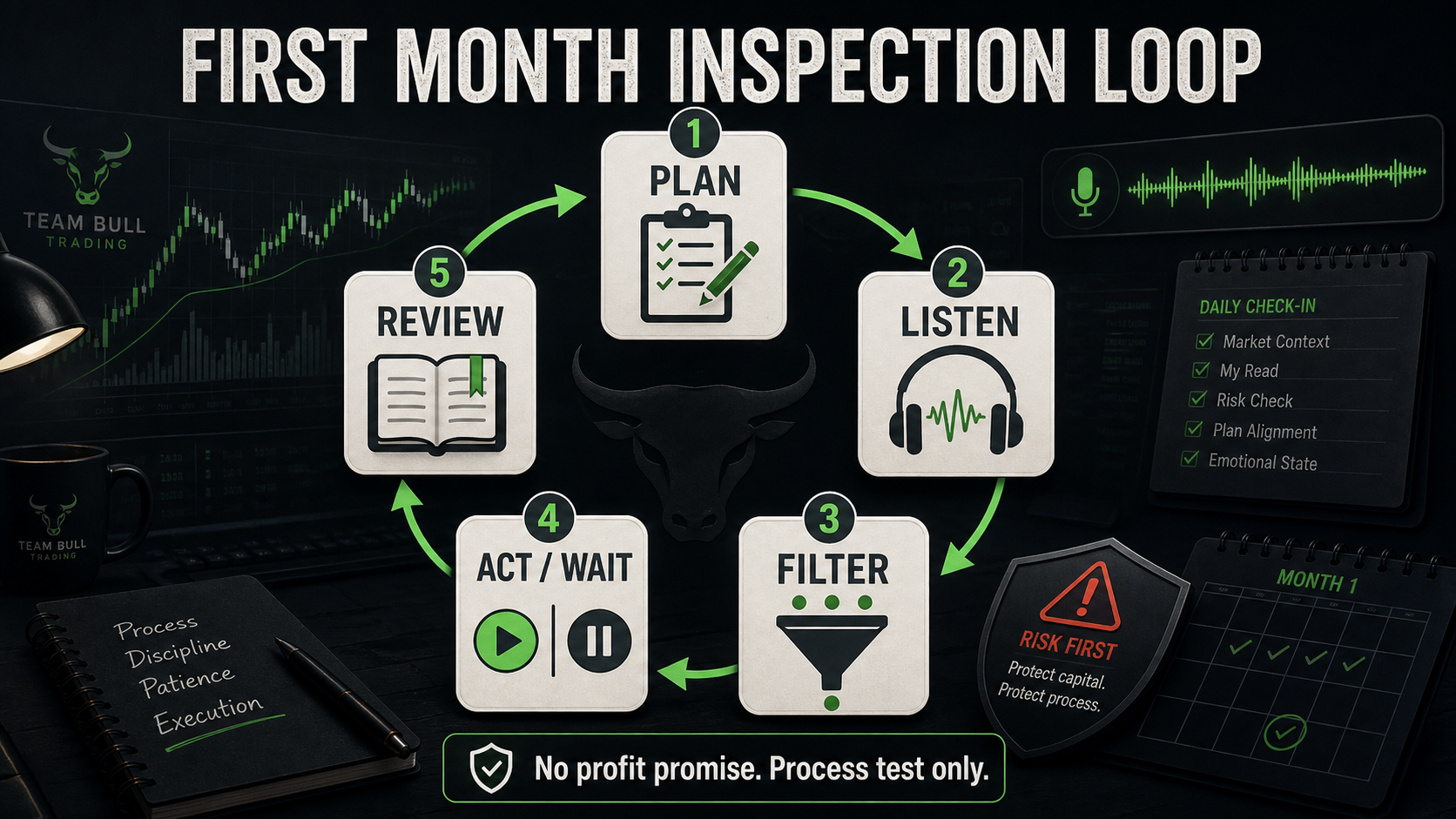
The time delay is lowered by changing the first result. You do not need a month of profits to know whether a session produced a useful note. You can know after one room session whether you captured thesis, risk, invalidation, and a reason to sit out. Effort is lowered by giving you a simple loop: plan, listen, filter, act or wait, review. The subscription only becomes valuable if that loop gets easier to run.
Your first win is a better note, not a green screenshot
The first useful result from a live trading room should be boring enough to trust. A better note is a real result. A note that names the setup, the thesis, the invalidation, the reason to wait, and the reason you did or did not act is a result. A note that shows you copied because a voice sounded confident is also a result, because it exposes the behavior you have to stop.
Profit is too noisy for a first-month diagnostic. A good trade can lose. A bad trade can win. A single green week can teach the wrong lesson. A single red week can hide a good process. If you judge the first month only by account outcome, you will either overtrust the room or blame it for a market sample too small to mean much.
Judge the first month by process evidence. Did you attend or replay sessions with attention? Did you record risk before action? Did you sit out when the idea did not fit your plan? Did live commentary make your thinking clearer or more impulsive? Did you end the week with reviewable material? If the answer is no, cancel or pause. If the answer is yes, you have a real reason to keep inspecting.
The buying choice is a sequence, not a button
Do not rush the click just because the offer has social proof. First inspect the public proof. Then compare offer paths. Then decide whether the monthly test fits your situation. Then decide what evidence would make you continue or cancel. That sequence protects you because the click has a job.
Jdun monthly is the clean first inspection when your fit is unknown. The $99/month price gives you a bounded test. Jdun yearly only makes sense after usage is already proven. The $999/year price is $189 less than twelve separate monthly payments, but a discount is not savings if you stop using the room after two weeks. Grizzly live is not a cheaper-vs-expensive decision because the visible monthly price is also $99. It is a communication and style decision.
Use the carousel sections as decision checkpoints. One walks through the first-month story. One compares offer paths. One turns common objections into rules. Do not treat them as decoration. Treat them as a way to slow yourself down before checkout.
Live voice is useful only when it changes what you notice
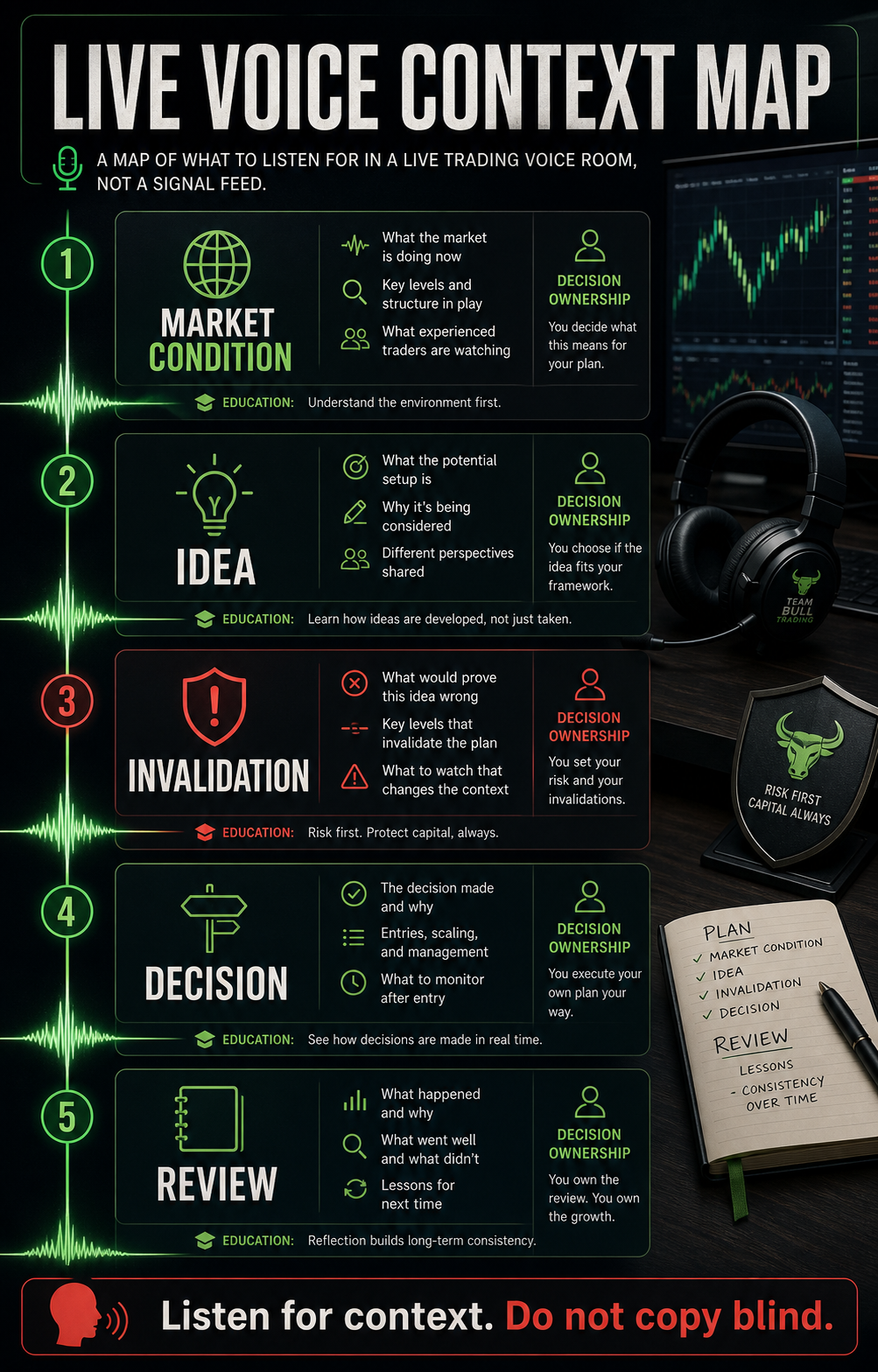
The strongest mechanism in a live trading environment is the chance to hear decisions before they become clean stories. A replay, a chart screenshot, or a polished thread often removes the messy part. Live voice can preserve the messy part: the wait, the uncertainty, the invalidation, the condition that has not appeared yet, the restraint that keeps a trader out of a tempting move.
That is valuable if you listen for reasoning. It is dangerous if you listen for commands. You do not benefit by asking, "What should I click?" You benefit by asking, "What is the speaker watching, what would make this idea wrong, what risk is being accepted, what would make sitting out correct, and how does this compare to my written plan?"
If you cannot hold that frame, a live room can become stimulation. Stimulation feels productive because there is movement, conversation, and urgency. Learning feels slower. It produces notes, rules, and restraint. Judge Team Bull by whether it helps you move from stimulation to learning. Make the membership earn the renewal.
The one-star slice is not a reason to ignore the offer
The visible one-star share matters because it keeps the decision honest. High ratings do not erase disappointed customers. Some people may have expected a different product. Some may have disliked the style. Some may have copied poorly. Some may have had real complaints. The public data does not explain every negative review, so do not invent a defense.
Use the negative slice as a pre-mortem. Before buying, ask what would make you disappointed after thirty days. Would it be too much live energy? Too little structure? Wrong schedule? Wrong mentor style? Not enough beginner explanation? Too much temptation to copy? A subscription that makes you feel you must trade to earn the fee back? Those questions are more useful than a wall of five-star praise.
The positive rating volume earns attention. The negative slice earns caution. The combination creates a better buying frame: inspect the room, define the job, set a cancellation rule, and do not turn public satisfaction into a private guarantee.
Who should buy, who should wait, and who should leave now
Team Bull is most likely to fit you if you already accept responsibility for risk and want a better environment around decision-making. You can afford the subscription without needing a trade to pay it back. You can take notes. You can attend or review sessions. You can hear an idea without instantly copying it. You judge education by whether your process improves, not by whether a single call wins.
You should wait if your main problem is not access but emotional pressure. If you are trying to win money back, wait. If the $99 monthly fee would make you force trades, wait. If you do not know what invalidation means in your own plan, wait. If you want someone else to decide entries and exits, wait. Waiting is not weakness. It is cheaper than buying the wrong product in the wrong state.
You should leave now if you want certainty. No room, no community, and no mentor can honestly provide that. Trading has risk. Education can support process. It cannot remove uncertainty. If that sentence ruins the offer for you, do not click.
The first month should have a cancellation rule before it starts
A clean first-month rule sounds like this: "I will cancel if I attend fewer than four useful sessions, produce fewer than four session notes, or feel more impulsive because of the room." That rule turns the subscription from a hope into a test. It also protects you from subscription drift, where you keep paying because cancellation feels like admitting you were wrong.
Write the rule before joining. Put it somewhere visible. Then use the room against the rule. After each session, write one line for thesis, one for risk, one for invalidation, one for your action or decision to wait, and one for what you learned about your own behavior. That is enough to know whether the environment is becoming useful.
If the notes improve, continue inspecting. If the room becomes background noise, cancel. If the room makes you chase, cancel faster. The goal is not to be loyal to a product. The goal is to be loyal to the trading process you are trying to build.
Yearly is a reward for proven behavior, not a discipline hack
The yearly math is simple: twelve monthly payments at $99 equals $1,188, while the visible yearly price is $999. That is a $189 difference if you would have stayed the full twelve months. The trap is using the discount to justify commitment before fit exists. Paying more up front does not create discipline. It often just hides a bad test for longer.
Yearly makes sense after proof. Proof means you used the room. You know the style fits. You can attend without forcing trades. Your notes improved. You understand the limitations. You would keep using it through slow weeks. At that point, the annual price is a rational comparison.
Before that, monthly is cleaner. Not because monthly is magically cheap, but because it gives you a sharper exit. Do not buy the biggest plan just because a bigger plan exists. Buy the smallest test that can answer the real question. The real question is not whether Team Bull has fans. It does. The real question is whether you can use the room in a way that improves your decisions.
The final click should feel calmer than the first impulse
A good buying decision should not make you more frantic. It should make the next small step calmer. If you are looking for permission to copy trades, Team Bull should feel less attractive after reading this. If you are looking for a live environment to test your process, the first month should feel clearer.
Here is the final decision rule. Start with Jdun monthly if you want the cleanest first inspection and can run the note-taking protocol. Compare yearly only after the room has already proven weekly use. Inspect Grizzly if the main question is mentor style and live communication fit. Do not buy any path if you need guaranteed profit, fast recovery, or someone else to carry your risk.
The next step is deliberately small: pick the offer path that matches your current proof level, set the cancellation rule, and judge the room by the notes it helps you produce. If the room improves the loop, keep testing. If it does not, leave. That is the most honest way to buy a live trading community.
A useful room should change the sentence in your head
Before a trader has structure, the sentence in the head is usually short and dangerous. "Should I take it?" That question arrives too late. It arrives when the chart is moving, when the room is talking, and when the trader is already emotionally leaning toward action. A live room that only feeds that question is not helping enough. It may be entertaining, but entertainment is a weak reason to pay for a trading subscription.
The better sentence is longer and calmer: "Does this idea match the setup I planned, can I name the risk, what would make it wrong, and am I still allowed to do nothing?" That sentence is not glamorous. It does not produce the same rush as jumping into a move because someone else sounds confident. It does something more valuable. It inserts a filter between stimulus and trade.
Use that as your standard for Team Bull. The live floor is useful if it helps you ask the longer sentence more often. The rating is useful if it gives you enough confidence to inspect the room. The monthly price is useful if it lets you test without turning the fee into a trade target. Bring every decision back to one inspection: does the room make your next sentence better?
Because this is an affiliate link, be stricter before you click
Because this is an affiliate recommendation, you should demand more friction, not less. Lazy affiliate copy hides caveats, makes broad claims, and treats you as ready before you have earned the click. You should distrust that. A useful recommendation tells you when to leave and gives you a sharper path only if the offer fits your situation.
That is why the misfit conditions have to be plain. Do not buy if you want guaranteed profit. Do not buy if you need to recover losses fast. Do not buy if the subscription fee creates pressure. Do not buy if you cannot define risk before entering a trade. These lines are not legal decoration. They matter because the product is only valuable when you can use it correctly.
The recommendation is still clear. Start with the monthly inspection if you have genuine interest and unproven fit. Compare yearly only after behavior proves usage. Inspect Grizzly as a style comparison, not as a magic alternative. Click only when you can name what the offer refuses to overpromise.
What to do in the first seven days if you join
Day one is not for copying. Day one is for orientation. Join the room, learn the rhythm, find where live commentary happens, and write down the markets and session times that actually match your life. Do not judge the entire product from the first exciting minute. Also do not ignore your first reaction. If the room makes you feel rushed, record that. If the room makes risk language clearer, record that too.
By the end of the first week, you should have at least two useful notes. A useful note does not need to be long. It needs five parts: the market situation, the idea being discussed, the risk or invalidation, your decision, and the post-session review. If all you have is "they called a move" or "I missed it," the room has not become learning material yet. You may still be consuming it like entertainment.
At day seven, do a small review. Did you attend because it fit your schedule or because you were chasing action? Did you understand the commentary well enough to filter it? Did you sit out at least once for a clear reason? Did the room make you more patient or more eager to click? If the first seven days produce cleaner notes, keep testing the month. If they produce pressure, treat that as evidence, not as something to push through.
The strongest honest promise you should accept
The strongest honest promise is not that Team Bull will make you profitable. The strongest honest promise is that you can inspect Team Bull before you pay and judge the first month without lying to yourself. That matters because you may be arriving in a fog: after losses, after clips, after screenshots, or after hearing that other people are inside a room you are not inside.
A sharper inspection is valuable because it changes the buying standard. Instead of asking "is this good?" you ask "what job will this do in my trading week?" Instead of asking "will this pay for itself?" you ask "can I afford to test this without pressure?" Instead of asking "which mentor is best?" you ask "which communication style makes my own decision process cleaner?" Those questions are less exciting, but they protect you.
If those questions make the offer feel too strict, wait. If they make the offer feel more useful, start with the monthly inspection and keep your cancellation rule visible. A live trading community should earn its place in your process one reviewed session at a time.
Want the lowest-commitment inspection?
Start with Jdun monthly, run the first-month note protocol, and cancel if the room creates pressure instead of clarity.
Inspect Jdun monthlyAlready proved Jdun fits your week?
Compare yearly only after you know you will attend, take notes, and keep using the room through slow weeks.
Compare Jdun yearlyUnsure about mentor style?
Look at Grizzly as a separate style test. Same visible monthly price; different fit question.
Inspect Grizzly live