 Team Bull Trading
The expensive false belief here is: free trading content is free, so paid access has to beat it by giving better picks. That sounds logical until you look at how traders actually use free content. The problem is not that free content is worthless. A lot of it is useful. The problem is that free content often arrives without sequence, feedback, accountability, risk context, or any pressure to review what you did with it.
The better belief is: you are not comparing free posts against Jdun’s paid room; you are comparing scattered consumption against structured repetition. That is the named mechanism for this article: the structured repetition advantage.
The visible buyer number is $99/month for the Jdun monthly offer. That number should not be treated as a profit hurdle. Treat it as the cost of testing whether live structure improves your learning process more than another month of random content.
Visible Team Bull facts at research time: the Jdun monthly offer is listed at $99/month; the Jdun yearly offer is listed at $999/year; the Grizzly offer is listed at $99/month; Team Bull Trading shows a visible 4.7 rating from 474 ratings, with a visible split of 87% five-star, 4% four-star, 2% three-star, 0.8% two-star, and 5% one-star. The public description positions Team Bull as a comprehensive trading community, and the visible FAQ prompts mention the trading floor and live voice trading sessions.
Trading involves risk. Treat live trading, commentary, alerts, and community discussion as education and decision support, not a promise of profit or personal financial advice.
Table of contents
- The real question
- Why free trading content feels enough
- Where free content breaks down
- The structured repetition advantage
- What the $99/month price should be compared against
- When free content is still the better choice
- The seven-day content audit
- How to use Jdun without becoming dependent
- FAQ
- Final decision rule
The real question
The question is not “can I learn trading for free?”
Yes, you can learn a lot for free. You can learn vocabulary, chart concepts, risk ideas, journaling formats, market structure, common mistakes, and the broad shape of almost any trading method without paying a subscription. Pretending otherwise would be dishonest.
The real question is narrower: is free content helping you make cleaner decisions, or is it giving you more material to react to?
That is where many traders get stuck. They do not lack content. They lack sequence. They watch one video about a setup, read a thread about another setup, see a confident chart on X, jump into a Discord conversation, save a screenshot, forget the screenshot, then repeat the cycle the next day. There is learning in there somewhere, but it is buried under motion.
Free content can make you feel productive while leaving your actual process untouched. You finish the night with ten tabs, three saved charts, two new terms, and no clear rule for what changes tomorrow. That is not education. It is content grazing.
Paid access only deserves a look if it can replace that chaos with repetition. Same room. Same broad style. Same recurring context. Same discipline language. Same chance to hear how decisions are framed live. That does not make the paid offer automatically better. It gives you a more concrete thing to test.
Related reading: Team Bull Trading Review: What You Actually Get Before Joining; What Live Voice Trading Sessions Can Teach Beginners.
Why free trading content feels enough
Free content feels enough because it gives quick relief.
You are confused, so you search. You are frustrated, so you watch. You are uncertain, so you read someone confident. The content gives your brain the feeling of progress. That feeling is not fake. It is just incomplete.
Trading content is especially good at creating that incomplete relief because it can show the clean part of a decision without showing the messy part. A chart after the move looks obvious. A clip after the result sounds calm. A thread can compress uncertainty into a neat sequence. By the time you consume it, the pain has been edited out.
Live trading content is different because the decision has not been cleaned by hindsight yet. That is the potential value. You can hear hesitation. You can hear invalidation. You can hear when someone does not take a trade. You can watch how a thesis changes or dies. You can notice whether risk is discussed before excitement.
But free content still has strengths. It is low-risk financially. It lets you sample many teachers. It can build vocabulary. It can help you decide whether trading education even interests you. A beginner who does not know the difference between entry and invalidation may be better served by free basics before paying anyone.
The mistake is not using free content. The mistake is confusing consumption with a learning system.
Where free content breaks down
Free content usually breaks in four places: sequence, pressure, feedback, and review.
Sequence breaks when every piece of content arrives as a separate island. You learn something about breakouts on Monday, risk management on Tuesday, options flow on Wednesday, psychology on Thursday, and then Friday’s trade is built from whichever idea is loudest in your head. Nothing forces the ideas into one operating system.
Pressure breaks because free content is often consumed away from the actual decision. You can agree with discipline at 10 p.m. and abandon it at 9:34 a.m. when the market moves. That gap matters. Trading education that never gets near the decision point can stay theoretical forever.
Feedback breaks because nobody sees what you did with the lesson. You may think you followed the idea, but your journal says otherwise. Or there is no journal. Or the journal records outcome but not decision quality. Free content rarely pushes back against your self-story.
Review breaks because the content stream keeps moving. There is always another clip, another chart, another opinion. Reviewing yesterday’s decision feels slower than consuming today’s new input. So the trader keeps learning new ideas while repeating old mistakes.
This is the gap Jdun’s paid live environment has to close. Not by being louder than free content. By making repetition, context, and review harder to avoid.
The structured repetition advantage
The structured repetition advantage is the idea that repeated exposure to one live educational environment can be more useful than endless exposure to disconnected advice.
Repetition lets you notice patterns. You hear how the same person handles different market conditions. You learn what they ignore. You learn what they repeat. You see whether discipline is only a slogan or part of the room’s rhythm. You can compare Monday’s discussion to Tuesday’s discussion and your own notes to both.
That is hard to get from scattered free content because the teacher, market context, timeframe, and vocabulary keep changing. Variety feels rich, but too much variety can prevent depth. You never stay with one method long enough to see its boundaries.
A paid live room can create a container. The container is valuable only if you use it correctly.
The right use is not: wait for a call, copy the idea, judge the room by the result.
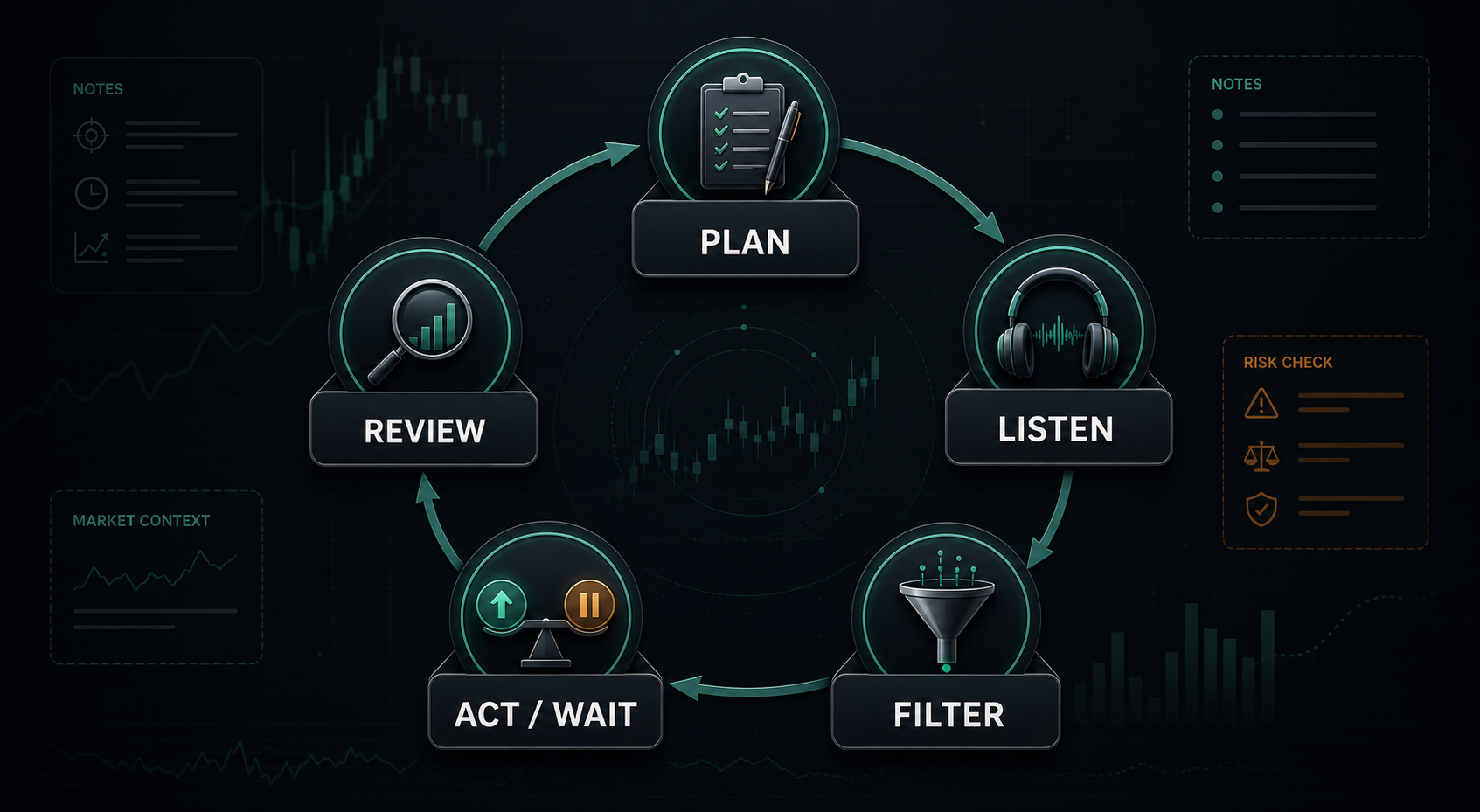
The right use is: listen for reasoning, note the risk, compare against your plan, act only if it fits, then review whether your process improved.
That is why the buyer should not ask, “Is Jdun better than free content?” Ask, “Does my current free-content habit produce structured repetition?” If the answer is yes, you may not need the paid room. If the answer is no, the monthly offer becomes worth inspecting.
What the $99/month price should be compared against
The weak comparison is $99/month versus $0.
The better comparison is $99/month versus your current learning leak.
Your learning leak might be time. How many hours did you spend last month consuming trading content that did not change one rule? Your leak might be attention. How many mornings did you start with a plan and abandon it after seeing a confident post? Your leak might be repetition. How many times did you relearn the same lesson because you never built it into a routine?
This is not a trick to make the paid offer look cheap. The paid offer can still be a bad buy. The point is that “free” is not the whole calculation.
If Jdun’s live room costs $99/month, then the first-month test should be specific. You are not trying to “get value” in the abstract. You are trying to find out whether the room gives you:
- A clearer weekly learning rhythm.
- Better notes before and after trades.
- More risk awareness before action.
- Less random content hopping.
- More ability to sit out when the trade does not fit.
If it does not produce those things, the free path may be better. If it does, the price has a real context.
When free content is still the better choice
Free content is still the better choice when you do not know what problem you are trying to solve.
If you are brand new, start with vocabulary. Learn what a stop is. Learn what invalidation means. Learn why position sizing matters. Learn why a trade can be a good decision and still lose. Learn why copying someone else’s entry without their context is dangerous.
Free content is also better when money is tight. Do not pay for a trading community with money you need for bills, rent, debt, or trading capital. A subscription that creates pressure will distort the way you judge the room. You will start needing it to “pay for itself,” and that expectation turns education into stress.
Free content is better when you already have a strong process. If you keep a journal, review weekly, manage risk, and know exactly what you are studying, you may not need a live room right now. Paid access is not a virtue. It is a tool. Tools are useful only when they fit the job.
Free content is better when you know you will not show up. A community you do not use is not education. It is a recurring charge with a nice story attached.
The honest CTA has to allow that. If the buyer is not ready, the best recommendation is to wait.
The seven-day content audit
Before paying, run a seven-day audit.
For one week, write down every piece of trading content you consume. Do not judge it yet. Just record it.
For each item, answer four questions:
1. What decision did this improve? 2. What rule did this change? 3. What risk idea did this clarify? 4. Did I review the idea later, or did I just move on?
Most traders will hate the answer. The list will be long. The actual changes will be short.
That gap is the argument for structure.
If free content is already producing clear changes, keep using it. If free content is mostly producing stimulation, Jdun’s paid room deserves a look because it may give your learning a container. Not because paid is morally better. Because repeated context can expose whether you are actually learning or just collecting opinions.
Related reading: Before You Buy Team Bull: 21 Questions to Ask Yourself; Disciplined Trading: Why Team Bull Reviews Keep Mentioning Discipline; Team Bull Trading Cost Calculator: Subscription, Time, and Risk.
How to use Jdun without becoming dependent
The danger of any live trading room is dependency.
Dependency sounds like this: “I do not know what to do until someone says something.” That is not education. That is outsourced judgment.
A healthier use sounds like this: “I have a plan. I am listening for context. I will compare what I hear against my own risk rules. If the idea does not fit, I do nothing.”
That distinction has to be explicit before joining. Otherwise live commentary can become a trigger.
Use Jdun as an observation room. Track how trade ideas are framed. Track when risk is mentioned. Track what gets skipped. Track what happens after a losing idea. Track whether the room reinforces discipline or action for action’s sake.
Then keep a journal. Not a results-only journal. A decision journal. Write what you heard, what you thought, what you did, and whether your action matched your plan.
If the room makes your journal clearer, it may be working. If the room makes your journal disappear, it is probably making you more reactive.
FAQ
Is paid trading education better than free content?
Not automatically. Paid education is better only when it gives structure, repetition, context, or feedback that free content is not giving you. If you already learn well for free, do not pay out of boredom.
Is Jdun worth $99/month compared with free YouTube or X content?
It depends on your current process. If free content is scattered and unreviewed, the monthly offer may be worth inspecting. If free content is part of a clear study routine, paying may be unnecessary.
Should I use Jdun for trade ideas?
Treat any live discussion as educational context, not personal instruction. Your own risk plan decides whether you act.
What should I do before buying?
Run the seven-day content audit. If your free-content habit is producing motion without structure, inspect the offer. If it is already producing better rules, keep the free process until you hit a real limit.
Final decision rule
Use this sentence before clicking:
“I am not checking Jdun because free content is bad. I am checking it because my free-content habit is scattered, unreviewed, and not changing my decisions.”
If that sentence feels false, wait.
If that sentence feels uncomfortably accurate, inspect the monthly Jdun offer here: https://whop.com/team-bull-trading/team-bull-trading?a=digitalartlab
Compare the bigger Team Bull review here: Team Bull Trading Review: What You Actually Get Before Joining.
Trading involves risk. Treat live trading, commentary, alerts, and community discussion as education and decision support, not a promise of profit or personal financial advice.