 Team Bull Trading
The expensive false belief here is: joining a trading group will make the hard parts beginner-friendly overnight. That belief gets beginners into trouble because it confuses access with readiness. A beginner can enter a live room, hear experienced language, and mistake confidence for clarity.
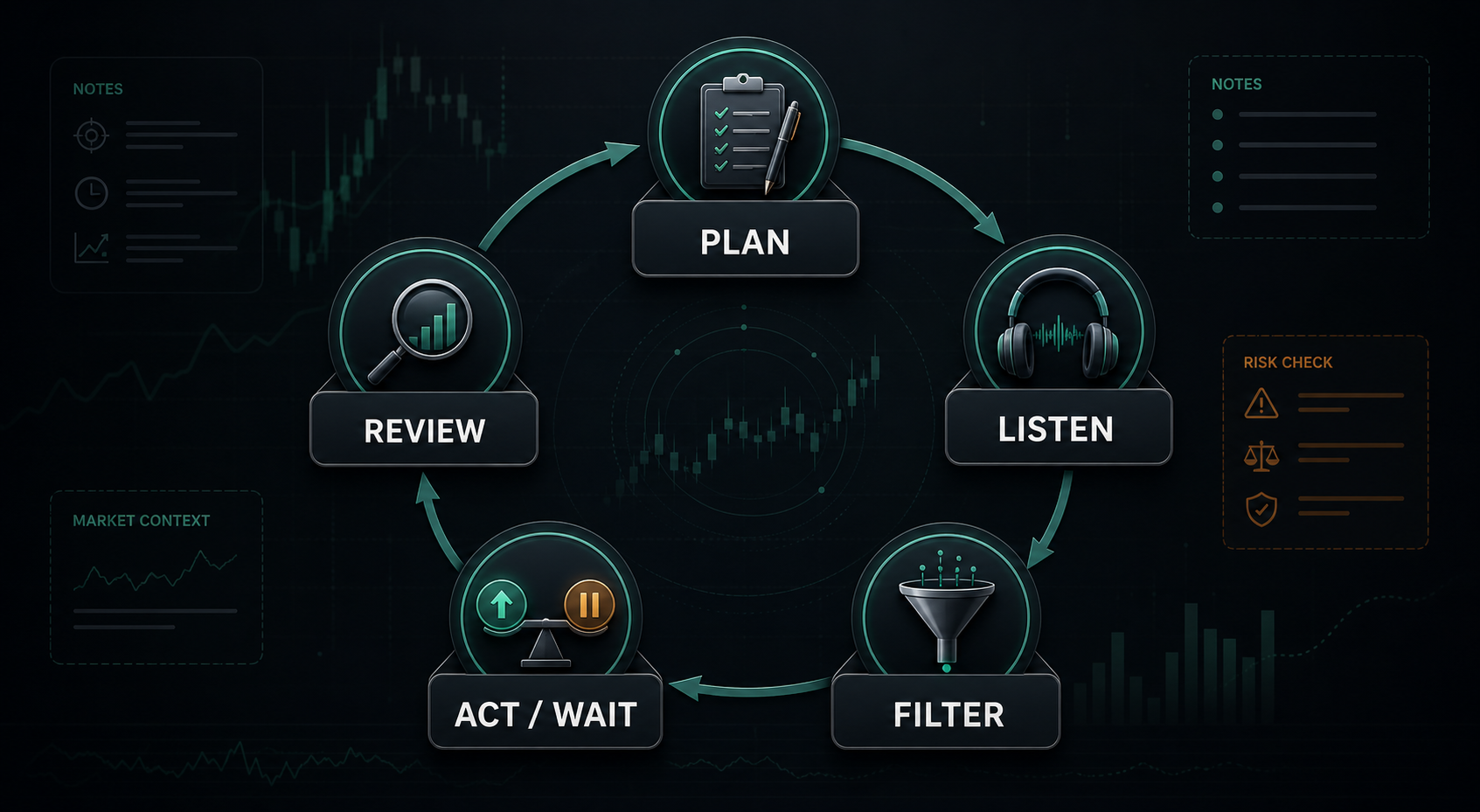
The better belief is: beginners need structure before speed. The named mechanism for this article is the beginner expectation filter. Before paying for live trading access, a beginner should know what they are trying to learn, what they are not ready to do, and what rules will stop live commentary from becoming pressure.
The visible offer facts are straightforward: Jdun monthly is listed at $99/month, Jdun yearly at $999/year, and Grizzly at $99/month. Team Bull shows a visible 4.7 rating from 474 ratings. Those facts justify inspection. They do not mean a beginner should rush.
Trading involves risk. Beginners should treat live trading discussion as education and market context, not instruction or a shortcut to results.
Table of contents
- The beginner warning
- What to learn before clicking
- How to use the first week
- Why live voice can overwhelm
- Risk rules for beginners
- The journal requirement
- When beginners should wait
- A 30-day beginner plan
- FAQ
- Final decision rule
The beginner warning

Beginners are most at risk when they are most excited.
That is not an insult. It is a trading reality. A beginner has less vocabulary, less pattern recognition, less emotional history, and less ability to separate useful confidence from dangerous confidence. A live room can accelerate learning, but it can also accelerate bad habits.
The main beginner mistake is treating a community as a replacement for foundations. A room can help you hear how people discuss trades. It cannot make you understand risk by default. It cannot stop you from copying. It cannot decide whether an idea fits your account.
A beginner should join only with a clear job for the membership. Not “I want to trade better.” Too vague. A better job is: “I want to learn how live traders discuss setups, risk, invalidation, and patience, and I will spend the first month observing before acting.”
That sentence protects you from turning the room into a signal machine.
Related reading: Live Voice Trading Sessions: What They Can and Cannot Fix; Disciplined Trading: Why Team Bull Reviews Keep Mentioning Discipline.
What to learn before clicking

Before paying, learn the basic language.
You do not need to be advanced. You do need enough vocabulary to understand what is being discussed.
At minimum, learn:
- Entry.
- Exit.
- Stop.
- Invalidation.
- Position size.
- Risk per trade.
- Thesis.
- Setup.
- Drawdown.
- Revenge trading.
- FOMO.
- Journal.
Those words are not decoration. They are safety equipment. If you do not understand invalidation, live commentary can sound like certainty. If you do not understand position sizing, a reasonable idea can become unreasonable in your account. If you do not understand FOMO, you may mistake urgency for opportunity.
Free content can help with this stage. Use it. A beginner should not pay because they are bored with basics. They should pay when basics are understood enough that live context becomes useful.
How to use the first week
The first week should be observation.
Do not make the first week about proving the room works. Do not make it about taking trades. Do not make it about judging one live idea. Make it about translation.
After each session, ask:
- What did I understand?
- What words did I not understand?
- Was risk discussed?
- Was invalidation clear?
- Did I feel pressure to act?
- Did I take notes or just listen emotionally?
This is not passive. Observation is work when it is structured.
A beginner who spends the first week observing may feel slower than other members. That is fine. Speed is not the goal. The goal is to avoid becoming dependent before you understand what is happening.
If you cannot explain the room after a week, do not trade from the room. Keep learning.
Why live voice can overwhelm

Live voice can overwhelm because it combines information with time pressure.
A written lesson waits for you. A live session moves. The market moves. People speak. Ideas appear. The beginner’s brain tries to keep up. That is where poor decisions start.
The danger is not only misunderstanding. The danger is emotional compression. A beginner may feel that if they do not act now, they are missing the point of the room. That is backwards. The point of the first month is not to capture every idea. The point is to learn how ideas are framed.
A beginner should give themselves permission to miss trades. More than permission: make it the rule. No live room should pressure a new trader into acting before they understand risk.
Use live voice like a classroom with moving examples. You are allowed to watch the example without participating in it.
Risk rules for beginners
A beginner needs risk rules before live access.
The rules do not need to be complex. They need to be written.
Start with these:
1. I do not act on a trade idea I cannot explain. 2. I do not trade without knowing invalidation. 3. I do not increase size because someone sounds confident. 4. I do not use money I cannot afford to lose. 5. I stop when emotion becomes the reason.
Those rules protect the beginner from the most common live-room failure: outsourcing judgment.
A community can teach language around risk. It cannot enforce your account boundaries. You have to bring the boundaries with you.
If those boundaries are not written, wait. The monthly price may be affordable, but the behavioral risk is not.
Related reading: Risk Management Lessons to Look For in a Trading Community; Before You Buy Team Bull: 21 Questions to Ask Yourself.
The journal requirement
Beginners should journal because memory lies.
After a session, it is easy to remember the exciting part and forget the confusion. It is easy to judge the room by outcome. It is easy to rewrite your own decision as more thoughtful than it was.
A beginner journal should be simple:
- What did I hear?
- What did I understand?
- What did I not understand?
- What risk was mentioned?
- What did I feel tempted to do?
- Did I act or observe?
- What do I need to learn next?
That journal makes progress visible. Without it, a beginner can spend a month in a live community and still not know what changed.
If the membership does not improve your notes, it may not be improving your learning.
When beginners should wait
Beginners should wait if the subscription creates pressure.
If $99/month feels like money you need to win back, wait. If you are joining after a loss because you want someone else to fix the feeling, wait. If you cannot define risk, wait. If you do not know what you would do in the first week besides listen for trades, wait.
Waiting is not failure. Waiting can be discipline.
Use the waiting period to learn vocabulary, build a journal, read the broader review, and define your first-month test. When you can explain how the room fits your learning plan, the monthly offer becomes more rational.
A 30-day beginner plan
Week one: observe and translate.
Week two: identify repeated terms and risk language.
Week three: take structured notes during live discussion. Still avoid rushing into action.
Week four: review whether the room made you clearer.
At the end, decide:
- Continue monthly if the room improved your process.
- Compare yearly only if fit is proven.
- Leave if the room made you reactive.
- Wait if you still do not understand the basics.
This plan makes the first month an education test, not a profit fantasy.
FAQ
Is Team Bull beginner-friendly?
A beginner can inspect it, but “beginner-friendly” should not mean “easy money.” Beginners still need vocabulary, risk rules, and patience.
Should beginners start monthly or yearly?
Monthly is the cleaner first test. Yearly should wait until fit is proven.
Can beginners use live voice trading?
Yes, as observation and education. Not as instruction to copy.
What should a beginner do before joining?
Learn basic terms, write risk rules, and define a first-month observation plan.
Final decision rule
Say this before clicking:
“I am joining to learn structure, vocabulary, risk, and live decision-making context. I am not joining to copy trades.”
If that sentence is true, inspect the monthly Jdun offer here: https://whop.com/team-bull-trading/team-bull-trading?a=digitalartlab
If you need the broader review first, read Team Bull Trading Review: What You Actually Get Before Joining.
Trading involves risk. Treat live trading, commentary, alerts, and community discussion as education and decision support, not a promise of profit or personal financial advice.