 Team Bull Trading
The expensive false belief is: an alternative means another trading room with a different name. That belief makes buyers compare logos, personalities, and screenshots while ignoring the real decision: what kind of support they actually need.
The better belief is: the real alternatives are different learning structures. The named mechanism is the support-type comparison.
Team Bull Trading publicly appears as a trading community with a trading floor and live voice trading sessions. Visible offers include Jdun monthly at $99/month, Jdun yearly at $999/year, and Grizzly at $99/month. Public rating data at research time shows 4.7 from 474 ratings, with a visible split including 87% five-star and 5% one-star ratings.
Trading involves risk. This comparison does not tell you which option will produce results. It helps you choose the structure that fits your current problem.
Table of contents
- The wrong way to compare alternatives
- Alternative 1: free trading content
- Alternative 2: self-study and journaling
- Alternative 3: paid courses
- Alternative 4: live trading rooms
- Alternative 5: private coaching
- Where Team Bull fits
- Decision matrix
- FAQ
- Final decision rule
The wrong way to compare alternatives

The wrong comparison is “Which community is best?”
That question is too broad to be useful. A beginner who needs vocabulary, a busy trader who needs a focused observation window, and a funded account trader who needs discipline pressure are not buying the same thing. Even if they land on the same Whop page, their actual problem is different.
Compare alternatives by support type:
- Information.
- Structure.
- Live context.
- Feedback.
- Accountability.
- Community.
- Mentor style.
- Cost and commitment.
A live room is not automatically better than free content. A paid course is not automatically better than a live room. Private coaching is not automatically worth the higher cost. The right alternative depends on the constraint.
If you do not name the constraint, the market will sell you whatever looks exciting.
Related reading: Jdun vs Free Trading Content and Team Bull Buyer Readiness.
Alternative 1: free trading content

Free content is the first alternative because it costs nothing and can be enough for the right learner.
Free videos, posts, livestream clips, and guides can teach language, chart concepts, common mistakes, and basic risk ideas. Team Bull itself has a related free product visible around disciplined trading principles. For someone who is still learning vocabulary, free content may be the correct first step.
The weakness of free content is fragmentation. You can watch one creator on trendlines, another on options, another on psychology, and end up with a pile of disconnected ideas. Free content also does not create a schedule unless you create one yourself.
Free content fits if:
- You are still learning terms.
- You are not ready to pay.
- You need basic discipline principles.
- You can organize your own study plan.
Free content fails if:
- You keep consuming without applying.
- You need live market context.
- You need a repeatable routine.
- You use free videos as entertainment.
If you cannot take notes from free content, paying for live access will not automatically fix that.
Alternative 2: self-study and journaling
Self-study is underrated because it is not flashy. But it may be the highest-return alternative for traders with poor discipline.
A journal forces you to see your actual behavior. Not your intention. Not your identity. Your behavior.
A useful journal tracks:
- Setup.
- Reason for entry.
- Risk amount.
- Invalidation.
- Management.
- Emotional state.
- Screenshot before and after.
- Lesson that survives the outcome.
Self-study fits if your main problem is repetition. If you take the same bad trade every week, another room may only give you more situations to repeat the habit. A journal makes the habit harder to hide.
The weakness is isolation. You may not know what you are missing. You may reinforce a bad interpretation. You may quit because there is no community pressure.
This is where a live room can help: not by replacing the journal, but by giving the journal better samples.
Alternative 3: paid courses

A paid course is structured information. It can be useful when you need curriculum more than live commentary.
Courses are often better for beginners who need ordered lessons. You can pause, replay, review, and learn at your own pace. A good course does not require the market to be open.
The weakness is that courses can become stale or too abstract. A course can teach the concept of risk management, but it cannot always show how decision-making feels when price is moving and emotions are active.
A paid course fits if:
- You need foundations.
- You cannot attend live sessions.
- You prefer quiet study.
- You need repeatable lessons.
A paid course fails if:
- You already know the concepts but cannot execute.
- You need live examples.
- You need community and accountability.
- You avoid the market by staying in course mode.
Alternative 4: live trading rooms
Team Bull belongs in this category.
A live trading room gives you current market context, real-time reasoning, community flow, and the chance to watch decisions unfold. That is the appeal of public wording around live voice trading sessions and the trading floor.
The advantage is immediacy. You can hear how a trader frames the day, adjusts to information, and responds when an idea stops working.
The danger is dependency. If you reduce the room to entries, you become weaker. If you treat every comment as a command, you lose your own process. If you chase after missing context, the room can make you worse.
A live room fits if:
- You already understand basics.
- You can observe without copying blindly.
- You can attend consistently.
- You want to study process under live conditions.
A live room fails if:
- You want certainty.
- You want someone else to carry your risk.
- You cannot afford the monthly cost calmly.
- You do not have rules for execution.
Related reading: Live Voice Trading Sessions.
Alternative 5: private coaching

Private coaching is different from a live room because the feedback is personal.
That can be powerful if your problem is specific and you already have trade data. A coach can review your journal, point out repeated mistakes, and help you adjust behavior.
The weakness is cost and quality variance. Coaching can be expensive, and not every coach is useful. It also works poorly if you have no data. A coach cannot diagnose habits you have not documented.
Private coaching fits if:
- You have a journal.
- You know your main problem.
- You need personal feedback.
- You can evaluate the coach's method.
Private coaching fails if:
- You are looking for motivation.
- You have no records.
- You want magic fixes.
- You cannot afford it without pressure.
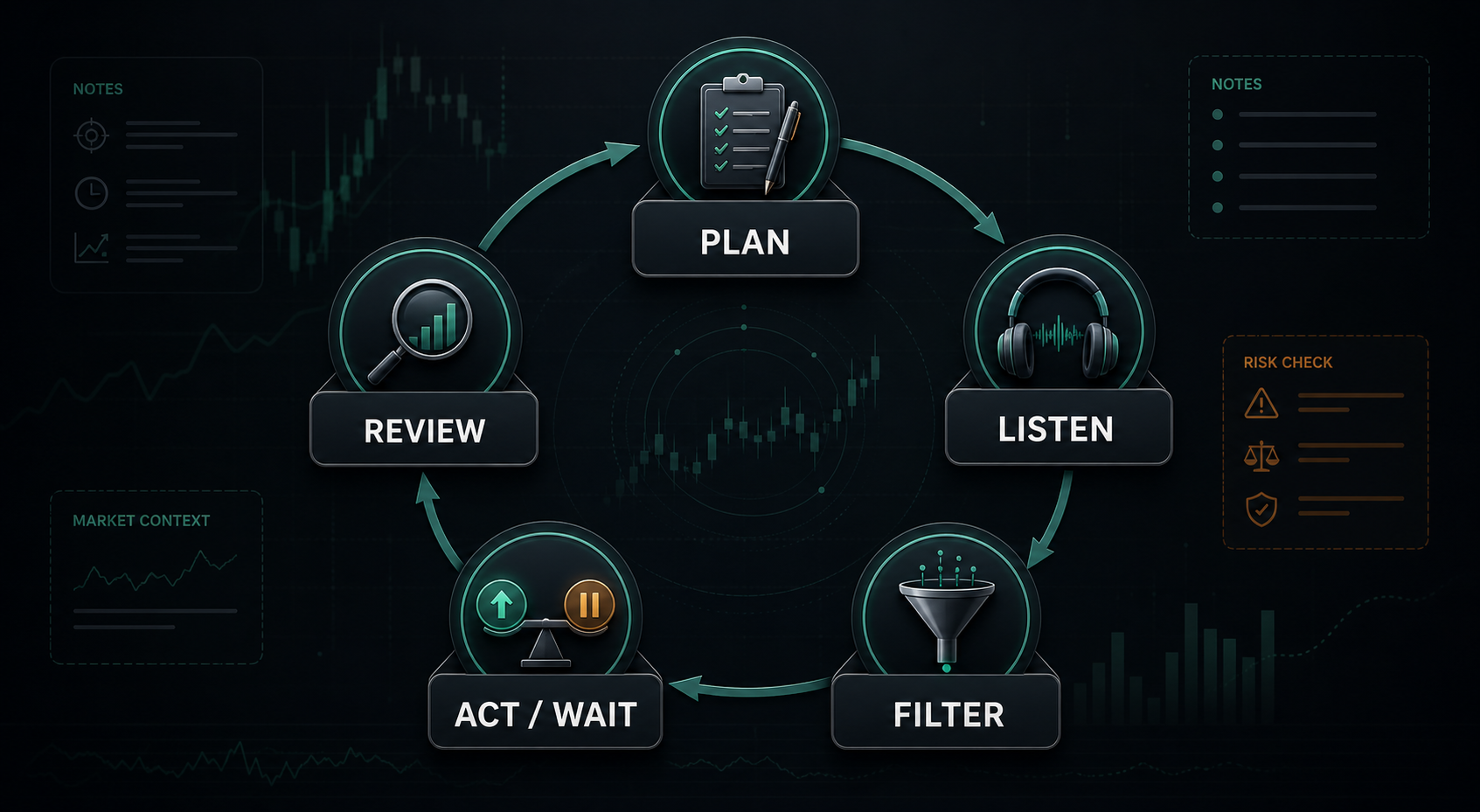
Where Team Bull fits
Team Bull fits the buyer who wants live context and community around trading.
It is not the cleanest first step for someone who has never learned basic risk language. It is not the right product for someone who wants guaranteed outcomes. It is not automatically the right annual purchase for someone who has never tested the room.
It can be a serious option for someone who wants to observe live reasoning, compare mentor style, and build a more consistent review habit.
That is why the monthly offer matters. $99/month lets you test support type. If support type is proven, the yearly price can be evaluated later.
Decision matrix
Use this practical matrix:
- Need vocabulary: start with free content.
- Need structure: consider a course.
- Need behavior visibility: journal first.
- Need live context: test a live room monthly.
- Need personal correction: consider coaching after journaling.
- Need certainty: do not buy trading products with that expectation.
This matrix keeps Team Bull in the right place. It is an option, not a universal answer.
FAQ
What is the best alternative to Team Bull?
The best alternative depends on your constraint. Free content, journaling, courses, live rooms, and coaching solve different problems.
Should beginners choose a course before Team Bull?
Many beginners should learn basics first. A live room is easier to use when you already understand risk language and chart context.
Is free content enough?
It can be if you are disciplined and can organize your own learning. It fails when consumption replaces application.
When should I test Team Bull?
Test it when you can observe live sessions, take notes, and evaluate process rather than chase entries.
Final decision rule
If your real need is live context and community, inspect the Jdun monthly offer here: https://whop.com/team-bull-trading/team-bull-trading?a=digitalartlab
If your real need is personal mentor style comparison, read Jdun vs Grizzly before choosing.
Trading involves risk. Choose the learning structure that fits your constraint, not the one that feels most exciting today.