 Team Bull Trading
The expensive false belief here is: a trading floor is just a chatroom with faster alerts. If that is how you evaluate one, you will look for the wrong signals. You will reward noise, speed, and confidence instead of preparation, risk framing, and review.
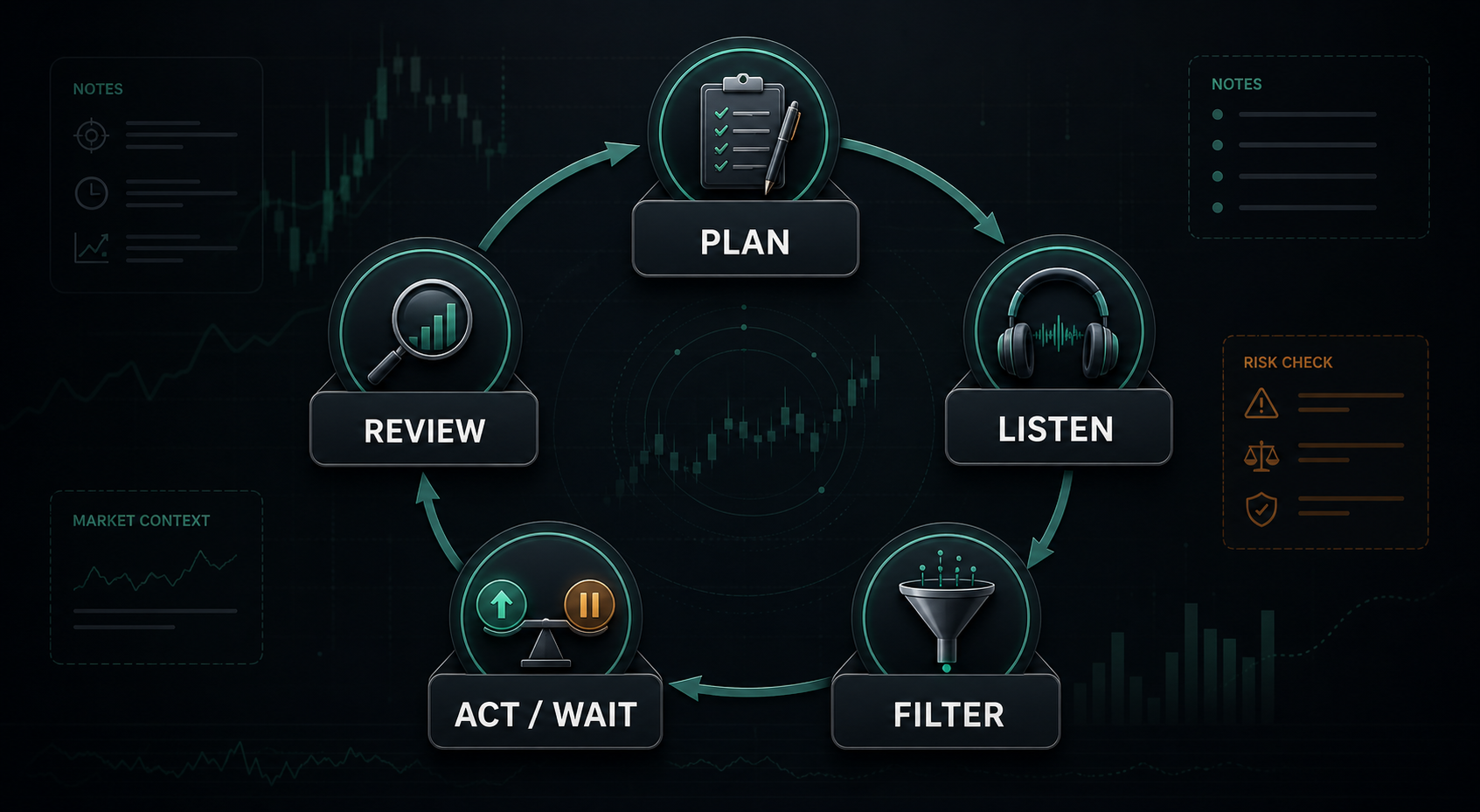
The better belief is: a useful trading floor gives structure to preparation, live context, risk framing, review, and restraint. The named mechanism is the trading floor utility stack.
Team Bull’s visible public page positions it as a comprehensive trading community. The visible FAQ prompts mention what makes the trading floor unique and how live voice sessions can help. Jdun monthly is listed at $99/month, Jdun yearly at $999/year, and Grizzly at $99/month. Those facts make the trading-floor question central.
Trading involves risk. Treat live trading floors as education and decision context, not a promise of profit or personal financial advice.
Table of contents
- The trading floor test
- Preparation
- Live context
- Risk framing
- Review culture
- Restraint
- The utility checklist
- How Team Bull fits the checklist
- FAQ
- Final decision rule
The trading floor test
A trading floor is useful only if it improves the moment before action.
That is the test. Not how busy it feels. Not how many people talk. Not how fast the room moves. Not how exciting the commentary sounds. The useful floor changes what a trader sees, asks, and writes down before making a decision.
A weak trading floor trains reaction. A useful trading floor trains inspection.
Reaction sounds like this: “Someone mentioned a trade, I feel late, I click.”
Inspection sounds like this: “I heard the idea, I understand the context, I know the risk, I know what would make it wrong, and it either fits my plan or it does not.”
That difference is the whole buyer checklist.
Team Bull should be inspected through that lens. If the trading floor helps members prepare, hear reasoning, define risk, review decisions, and tolerate sitting out, it may be useful. If it only creates more urgency, it may be a bad fit even if the room feels active.
Related reading: Live Voice Trading Sessions: What They Can and Cannot Fix; Team Bull Trading Review: What You Actually Get Before Joining.
Preparation
Preparation is the first layer of the utility stack.
Before the market becomes emotional, a useful trading floor should help orient attention. What matters today? What conditions are worth watching? What should be ignored? What kind of day might make trading harder? What levels, themes, or risks are relevant?
Preparation matters because most bad trades do not feel bad at the start. They feel urgent. A trader without preparation is easier to drag around by whatever appears next.
A prepared trader can say, “This idea is not part of today’s plan.” That sentence is underrated. It protects the trader from treating every live comment as an invitation.
For Team Bull, the preparation question is practical: does the room help you enter the session with more structure than you had alone? If yes, the trading floor has a job. If no, it may be only another feed.
Live context
Live context is the second layer.
Live context is not “someone is speaking while the market is open.” Live context means the room helps you understand what is changing and why the decision is still uncertain.
A useful live floor reveals the thinking around a possible trade. Why now? Why wait? What changed? What would make this invalid? Why is this not worth taking? What is the difference between a clean setup and a forced one?
That context is valuable because it appears before the outcome. After the outcome, everyone can sound wise. Before the outcome, process is visible.
The buyer should listen less for action and more for reasoning. If you leave with better reasoning, the live context helped. If you leave only with more adrenaline, it did not.
Risk framing
Risk framing is the layer that separates education from entertainment.
A trading floor that only talks about opportunity can feel good while training bad habits. Risk language forces the decision to become real. Where is invalidation? What is the downside? What size makes sense? What conditions would make this a no-trade?
Risk framing does not make trading safe. Nothing does. It makes the decision more reviewable.
A useful floor normalises sentences like:
- This is not clean enough.
- This needs confirmation.
- This is too late for me.
- Risk is not defined.
- Size has to stay small.
- Sitting out is fine.
Those sentences may be less exciting than a hot call. They are also more useful for long-term education.
Review culture
A trading floor becomes more valuable after the session if it supports review.
The session itself is only part of learning. The review is where patterns become visible. Did you understand the idea? Did you follow your rule? Did you act from plan or pressure? Did you sit out when appropriate? Did the room help you think or make you chase?
A useful trading floor gives you material to review. A weak one gives you a blur.
This is why notes matter. If you cannot write down what you heard, what you thought, and what you did, you cannot learn much from the room. The product may be active, but your process is invisible.
A buyer should ask: after a week, are my notes better? If yes, the trading floor is doing real work. If no, the room may be entertainment.
Related reading: How to Journal Trades While Following a Live Trading Room; Disciplined Trading: Why Team Bull Reviews Keep Mentioning Discipline.
Restraint
Restraint is the final layer because it is the easiest to fake and the hardest to practice.
A trading floor that never makes restraint visible can turn into a pressure machine. Every room has action. The question is whether the room respects no-action.
Restraint looks like waiting. It looks like reducing size. It looks like passing on a setup. It looks like admitting the market is messy. It looks like not forcing a trade because people are watching.
For beginners especially, restraint may be the most valuable lesson. A beginner does not need more reasons to click. A beginner needs better reasons to pause.
If Team Bull’s trading floor helps you pause intelligently, that is a strong utility signal.
The utility checklist
Use this checklist before judging the room:
1. Does it help me prepare before action? 2. Does it provide live context, not just commands? 3. Does it make risk visible? 4. Does it make invalidation understandable? 5. Does it encourage notes and review? 6. Does it normalise sitting out? 7. Does it reduce my random-content habit? 8. Does it make me less reactive after a week? 9. Can I afford it without pressure? 10. Do I know when I would cancel?
If most answers are yes, the trading floor may be useful. If most are no, the offer may not fit you.
How Team Bull fits the checklist
The public page gives enough to inspect, not enough to conclude.
The mention of the trading floor and live voice sessions makes the utility stack relevant. The 4.7 rating from 474 ratings makes the offer worth researching. The $99/month Jdun and Grizzly prices make the first-month test concrete.
But the real answer comes from use. You have to enter the room, take notes, and evaluate behavior. Did the environment support the utility stack or not?
That is why the monthly path is the cleanest first test for new buyers.
FAQ
Is a trading floor the same as an alert room?
No. A useful trading floor should provide context, risk discussion, preparation, and review material. An alert room may only provide ideas.
What is the most important trading floor feature?
Risk framing. Without risk, live commentary can become pressure.
How should beginners use a trading floor?
Observe first. Take notes. Listen for reasoning and risk before acting.
How does this apply to Team Bull?
Use the public Team Bull facts to justify inspection, then test whether the trading floor improves your process.
Final decision rule
Say this before clicking:
“I am inspecting the trading floor because I want preparation, context, risk, review, and restraint. I am not looking for a chatroom to make decisions for me.”
Inspect the Jdun monthly offer here: https://whop.com/team-bull-trading/team-bull-trading?a=digitalartlab
Inspect the Grizzly live-trading offer here: https://whop.com/team-bull-trading/live-trading-with-jd-copy?a=digitalartlab
Trading involves risk. Treat live trading floors as education and decision context, not a promise of profit or personal financial advice.